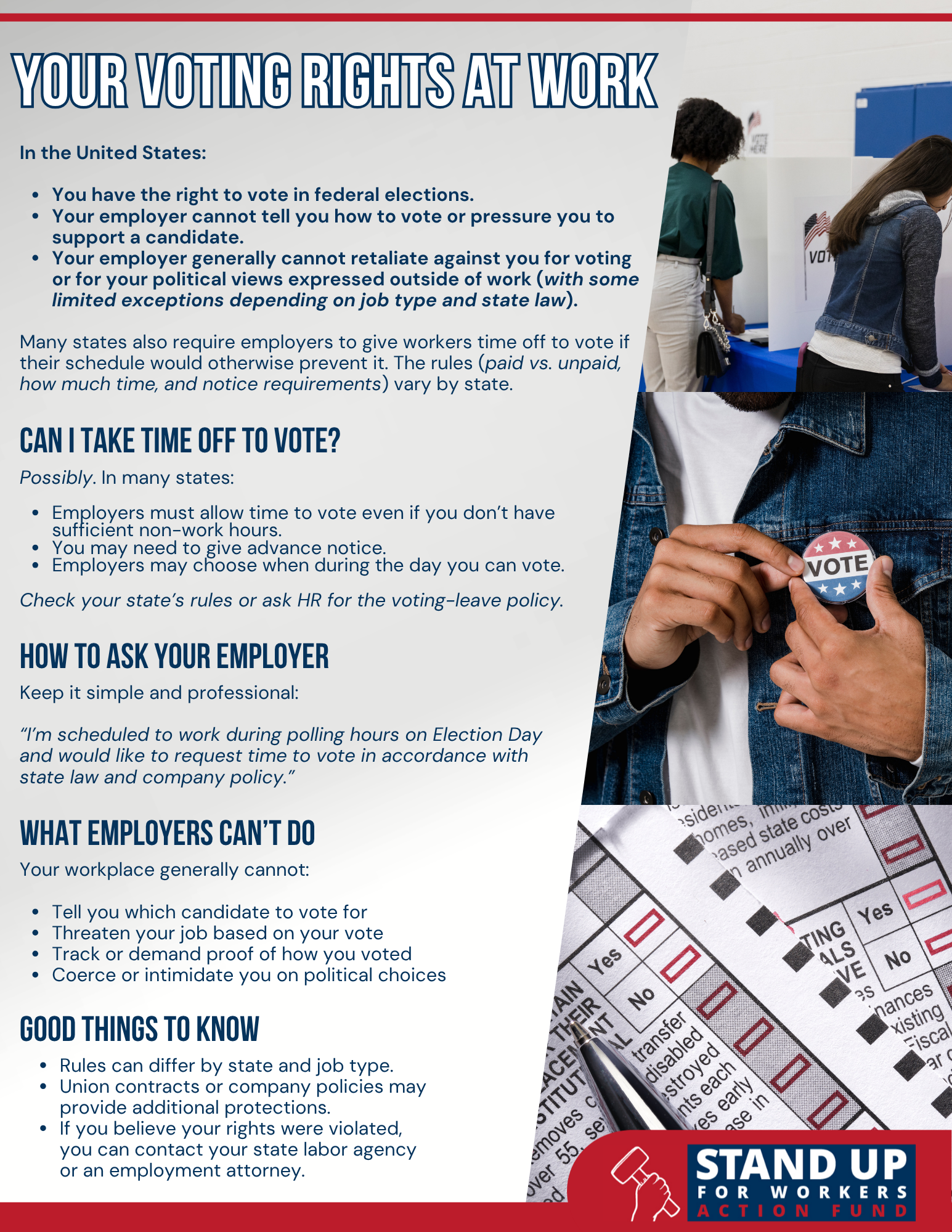
New Resource: Voting Rights at Work

Whether you’re working a shift, managing a team, or balancing a packed schedule, you have rights that protect your ability to vote.

This resource is designed to help you and your network understand what those rights are, how to use them, and how to plan ahead with confidence.

Being informed gives you power as a citizen. Hang this flyer at work. Share it with colleagues. Send it to your group chat.

Oregon Campaign for Just Cause

On November 3, 2026, Oregon voters may have the opportunity to approve a fundamental revision in the employment laws of that state. That revision would reverse a doctrine that has been adopted in all but one American state, and that has been used to destroy labor unions, weaken the protections adopted by the Congress and the Oregon legislature, and impair the respect that American workers receive for the work they perform.

The doctrine has a name: employment at will. It was first articulated in a treatise on employment rights in 1877, written by a railroad lawyer, and it was soon adopted as part of the legal regime supporting the Industrial Revolution. The doctrine claims that every employment for an indefinite period of time – that is, virtually every job in America – can be terminated at the will of the employer, without a reason, at any time, with no right to recover damages. The prior rule was that every “hiring” would be for a period of one year.

The new doctrine of employment at will has been rejected by every other industrialized nation. In the U.S., only Montana and Puerto Rico require that every contract of employment can be terminated only for just cause. Under this doctrine, employees have no protection from being fired for arbitrary reasons, without any prior warning or prior discipline, even if they have worked effectively for their employers for years. Some employers have established policies and procedures that seem to promise fair treatment, but then state that those provisions are not contractual and cannot be the basis for a lawsuit.

According to a recent national survey of workers:

  • 69% of workers said their employment was terminated for no reason or for what they claimed to be an unfair reason
  • 75% of workers were fired without warning or any opportunity to improve their work performance

Workers routinely accept demeaning, unsafe or even dangerous working conditions to avoid being disciplined or fired:

  • 59% of workers have skipped work breaks
  • 57% of them have worked overtime when they would have preferred not to work
  • 44% of workers have put up with verbal abuse from a manager or supervisor
  • 35% of workers have worked under dangerous or unsafe conditions
  • 33% of them accepted less pay than what was owed to them

This affects the health and safety of workers. In order to avoid being disciplined:

  • 66% of workers have worked while sick or injured
  • 47% of them postponed medical care
  • 45% of them neglected important family responsibilities or events

Oregon Initiative 36, if adopted by the voters, would eliminate the doctrine of at will, and would restore the respect that Oregon workers deserve. It would require that all Oregon employees, other than seasonal employees and employees hired for a specific term, would have four rights:

A property right to employment. All Oregon employers could impose disciplinary procedures or discharge only based on (a) just cause and due process, and providing (b) a severance payment. Employers would need to provide notice and adequate training on work rules, apply those work rules reasonably and consistently, perform a sufficient and fair investigation, and discipline employees appropriately and proportionately.

A right to good faith notice. Employers would need to notify employees before disciplining or discharging them, inform them of the nature of the investigation and of the alleged facts, and complete any investigation within a reasonable amount of time.

A right to association. Employees would be entitled to representation before being required to answer questions. Interviews generally will be conducted during working hours.

A right to security. Employees will be entitled to severance pay from the date of hire, unless for a seasonal layoff.

A right to remedy. Employees shall have a private right of action to seek relief and compensation for severe disciplinary action without just cause, and to seek just compensation severance, including prevailing plaintiff attorney fees.

The proponents for Oregon Initiative 36 are now working to gather no less than 156,231 petition signatures to get that measure on the November 2026 ballot. Working with their allies in the labor union movement, Jobs with Justice, the National Employment Law Project, the Democratic Party of Oregon, Democratic Socialists of America and Democratic Socialists of America, they will be circulating petitions at events in Oregon and doing other canvassing in the next four months. That will include the No Kings marches on March 28, the Portland Rose Festival, sports events, county fairs, farmers’ markets, and every place that people come to gather and to enjoy the spring and early summer weather.

This initiative will have strong bipartisan support. Just-cause policies are supported by 66% of all workers, including by:

  • 61% of Republican workers
  • 66% of Democratic workers
  • 72% of independent workers

This point is worth repeating. We are living in a time of intense political polarization in the United States. 64% of voters feel that the American political system is too politically divided to solve the nation’s problems. 80% of all adults feel that members of the opposite political party not only disagree about plans and policies, but cannot agree on basic facts.

Nearly half of adults feel that members of the opposing political party are “downright evil.” In this climate, it is remarkable that nearly identical percentages of workers from both political parties support just-cause policies. In fact, support for this pro-worker measure is strongest among independents, not by political partisans! Those policies are supported by two-thirds of all workers!

You can donate funds to support this effort at www.OUJC.org/Give. Donations are not tax-deductible. We encourage you to support this important initiative.

Written By Barry Roseman, Stand Up For Workers Board Member

Candidate Spotlight: Jon Ossoff

Senior U.S. Senator Jon Ossoff of Georgia is one of the first senate candidates  the SU4W PAC supported and is currently being considered for support again as he runs for re-election. 

In his last election in 2020, Ossoff, along with junior Sen. Raphael Warnock, set new “firsts” for Georgia, as Ossoff was the first Jewish candidate, and Warnock the first African-American, to be elected to the U.S. Senate from the state.  Ossoff, whose race has been called the most expensive in U.S. history, defeated Republican incumbent David Perdue in a January runoff election after no candidate won a majority in the general election.  Ossoff’s and Warnock’s victories gave Democrats control of the Senate. At thirty-eight years of age he is currently the youngest senator in office.

Ossoff graduated from Georgetown University‘s Walsh School of Foreign Service with a Bachelor of Science in culture and politics, and earned a Master of Science degree in international political economy from the London School of Economics in 2013. Elements of Ossoff’s background of interest to worker advocates include his serving as intern for civil rights leader and U.S. Representative John Lewis. From 2007 to 2012 he served as legislative assistant for foreign affairs and defense policy for U.S. representative Hank Johnson.

From 2013 to 2021, Ossoff was the managing director and chief executive officer of Insight: The World Investigates (TWI), a London-based investigative television production company that works with reporters to create documentaries about corruption in foreign countries. The firm produced BBC investigations about ISIS war crimes and death squads in East Africa. He invested a previously received inheritance of an unknown amount to the TWI venture.

Ossoff ran unsuccessfully for Congress in 2017.  Though he lost, The New York Times reported that he “produced probably the strongest Democratic turnout in an off-year election in at least a decade“, “brought a surprising number of irregular young and nonwhite voters to the polls,” and nearly doubled youth turnout in the 6th district from the 2014 midterm election, in a district where Republicans far outnumber Democrats.

Ossoff won the support of our PAC by his pledge respecting federal judicial appointments, that if elected he would vote to approve only judicial nominees who have stated their openness to and support of the rights of workers; and by his avowals of commitment to endorsing and promoting legislation that broadens or strengthens worker rights.  Along with SU4W PAC’s endorsement, in the 2020 race he also won the endorsement of the Everytown for Gun Safety Action Fund.

As senator, Ossoff has been active in a variety of areas, but pro-worker legislation has not appeared to be a major focus for him.  He initiated the Solar Energy Manufacturing for America Act, which was passed by the senate in 2022, and which held the promise of more manufacturing jobs.  It was incorporated into the Infrastructure and Jobs Act.  He also sought more control over the U.S. postmaster general in the wake of a mail service meltdown.  Earlier this year the Associated Press noted Ossoff’s bipartisan work with Republicans, advancing the interests of Georgia’s farmers and military bases.

Ossoff voted for the Infrastructure Investment and Jobs Act and the American Rescue Plan Act of 2021, and has supported legislation that significantly benefited workers along with others, including the Affordable Care Act and the Equality Act, which would prohibit discrimination on the basis of sex, gender identity, and sexual orientation.  He has also called for the repeal of “wasteful, anti-competitive special interest subsidies that make it hard for entrepreneurs to raise capital …  [and] create jobs … .”  He describes his support for the LGBTQ community as “unwavering” and supports comprehensive immigration reform with a path to citizenship for immigrants not currently documented.

In 2022, he blocked a proposed titanium mine in the Okefenokee Swamp after the U.S. Fish and Wildlife Service warned of severe potential damage to the wildlife refuge. The mine was proposed by Twin Pines Minerals LLC in 2018.

Alongside his votes supporting workers, however, Ossoff’s Senate record also appears to include at least one less-than-supportive item.  The United Farm Workers and the S.E.I.U. union report that he joined forces with a Republican, Sen. Thom Tillis of North Carolina,  to introduce a bill delaying a five-percent wage increase for H-2A Visa workers for nine months. A March 2022 statement from Tillis announced that Ossoff had joined him in sponsoring the legislation to support farmers.  Ossoff, who the unions note also supported legislation raising the federal minimum wage to fifteen dollars, denies favoring wage cuts for farm workers and points out that he has been a champion for paid leave and for the right to join a union.  Agriculture represents more than five percent of  Georgia’s economy, so it may not be surprising that Ossoff joined in that bill, and it may be that this bipartisan step explains why in one recent poll of voters, Ossoff was supported by some twenty percent of Georgia Republicans.

In the final analysis, living in a democratic system of government calls for pragmatism and compromise.  While Ossoff may not prioritize workers’ rights as highly as advocates may wish, his record overall is almost certainly preferable to the Republican candidate (whoever that turns out to be) for the seat.

Written By Paul Merry, SU4W Board Member