The Fifteenth Amendment and Callais

I wrote an article in the May issue of the Stand Up For Workers newsletter about the Supreme Court’s decision in Louisiana v. Callais. I only briefly mentioned the Fifteenth Amendment to the U.S Constitution in that piece.

The Callais majority decision effectively determined that Sec. 2 of the Voting Rights Act was unconstitutional, while claiming that it was merely “updat[ing]” the framework for determining whether Sec. 2 has been violated. That was a cynical exercise of the conservative majority’s power. The majority opinion would have been more intellectually honest if it had said what it was doing. The claim that it was just updating the Sec. 2 framework fooled no one.

Sec. 2 was enacted pursuant to both the Fourteenth and Fifteenth Amendments.

The Fifteenth Amendment prohibits the states from “deny[ing] or abridg[ing]” the “right of citizens of the United States to vote” because of their “race.” In fact, the Fifteenth Amendment is the only provision in the Constitution that expressly prohibits racial discrimination.

Southern states diluted Black citizens’ votes by gerrymandering congressional districts as early as the 1870s. The Supreme Court in 1980 rejected a claim of racial dilution pursuant to Sec. 2 because the plaintiffs had not proven that the dilution scheme was done for a racial reason. Congress rejected that interpretation of Sec. 2.

In its 1982 amendments to the VRA, it expressly supported racial-dilution claims and provided that it is not necessary to prove discriminatory intent to prevail on such claims. Congress had the power to adopt the amended Sec. 2 pursuant to the Fifteenth Amendment, which grants Congress the “power to enforce this [amendment] by appropriate legislation.” The Supreme Court, in 1966, decided that “Congress may use any rational means to effectuate the constitutional prohibition of racial discrimination in voting.” The Callais majority concluded that that Fifteenth Amendment power is limited to efforts to end intentional racial discrimination in voting. The majority reasoned that redistricting for partisan reasons does not violate Sec. 2. But voting by Black voters in the South is highly partisan now, as it was in the 1870s and 1880s. Partisan redistricting is racial redistricting, especially in the South, where almost all Black individuals and relatively few white people vote for Democrats. Congress amended Sec. 2 because Southern state legislatures solemnly stated that they had no racial animus is drawing district lines.

That is nonsense. Of course they did, since they knew the penalties of being honest about their intent.

State legislatures are populated and advised by lawyers. State legislators are acutely aware of the importance of legislative district boundaries. They know where the district boundaries are located and know that Black voters in the South overwhelmingly vote for Democrats.

The drawing of district boundaries is an intentional act. Sec. 2 was amended because evidence of racial results is evidence of racial intent. It is not necessary to find direct evidence of racial intent, since that intent is inferred from legislatures’ intentional decisions to create districts that result in racial discrimination.

Callais is written from the perspective of the white majority legal and political system in this country. Black citizens in the South – with the apparent exception of Justice Thomas – understand that racial discrimination is alive and well in their state legislatures. The Voting Rights Act was adopted to end that discrimination. As a result of Callais, that discrimination is alive and well.

It is ironic that as this country celebrates the 250th anniversary of the adoption of the Declaration of Independence, the aftermath of the peculiar institution of slavery continues to rear its ugly head in the heart of this democracy. The Callais decision will destroy Black representation in most of the South, until and unless it is overturned or until Congress abolishes partisan gerrymandering or requires proportional representation for congressional districts.

*******

On June 2, 2026, by a vote of 6-3, a majority of the Supreme Court granted a motion for stay in Allen v. Milligan, after a three-judge panel in the Southern District of Alabama concluded that the Alabama state legislature had intentionally discriminated on the basis of race in creating a legislative map that included only one Black-majority congressional district.

The Supreme Court decided in the same case in 2023 that Alabama’s congressional map unlawfully discriminated on the basis of race against Black residents of that state. The district court then held an 11-day trial in which 51 witnesses testified and almost 800 exhibits were exhibited into evidence. The district court concluded that the legislature acted with a discriminatory purpose and not for partisan reasons. The Supreme Court ignored that clear evidentiary record in allowing Alabama to hold an election with only one Black-majority district this year.

Written by Barry Roseman, SU4W Board Member

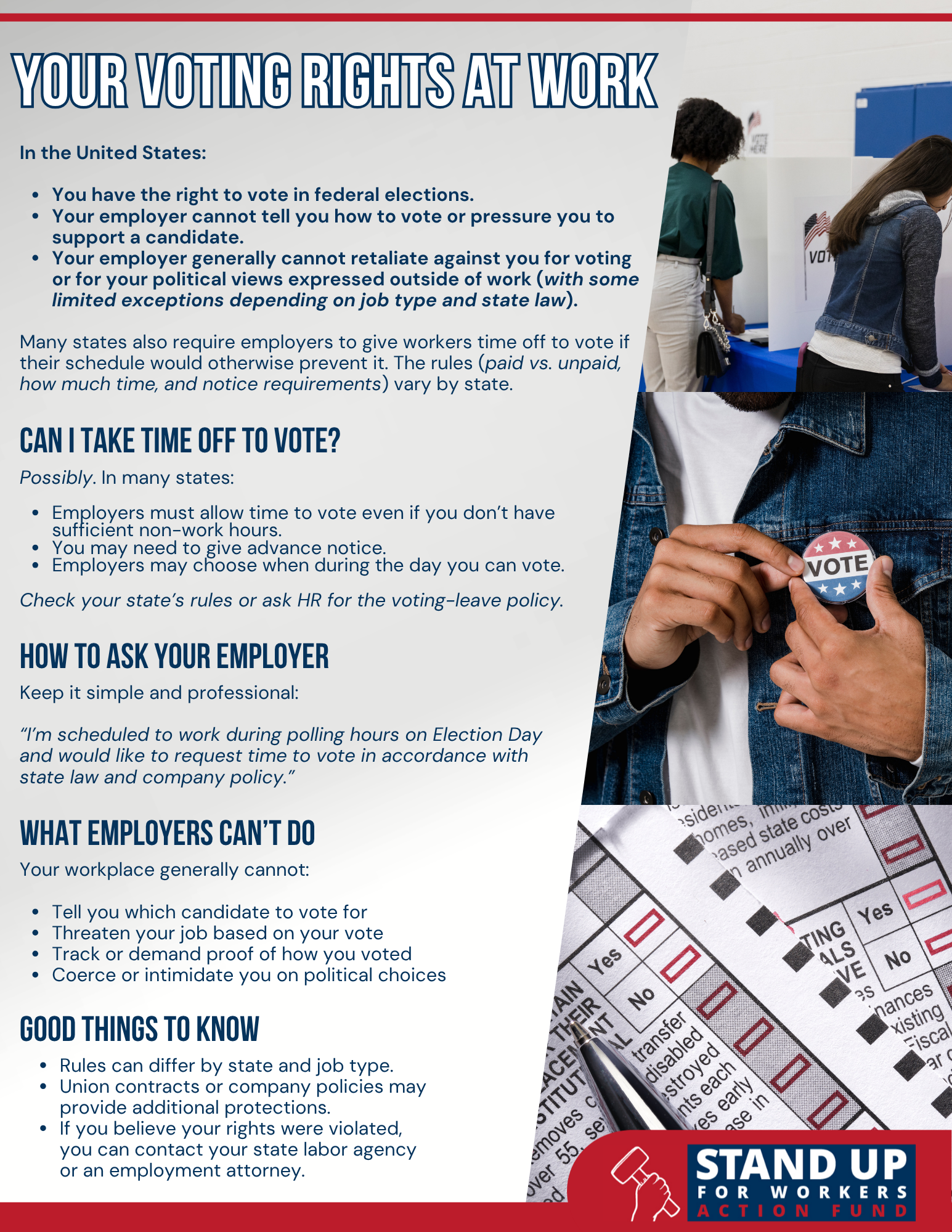
New Resource: Voting Rights at Work

Whether you’re working a shift, managing a team, or balancing a packed schedule, you have rights that protect your ability to vote.

This resource is designed to help you and your network understand what those rights are, how to use them, and how to plan ahead with confidence.

Being informed gives you power as a citizen. Hang this flyer at work. Share it with colleagues. Send it to your group chat.

Opinion: We Need Guardrails

As a long-time resident of Colorado, I appreciate guardrails.

Let me give you an example.

When I drive from Denver to Winter Park, Granby and Steamboat Springs, Colorado, I need to go over Berthoud Pass on U.S. 40. I rely on guardrails on the eastern approach to Berthoud to protect against situations like a flat tire, driving when exhausted, or even an avalanche — all of which could plunge me hundreds of feet to the valley floor without that barrier.

The Oxford English Dictionary defines “guardrail” as “a bar along the edge of something steep, such as stairs or a cliff, to prevent people from falling off.” But the term is also used metaphorically to refer to regulations or frameworks designed to ensure ethical conduct and prevent abuses of power.

Vice President Harris warned voters in 2024 that Donald Trump, if re-elected as president, would not have any effective guardrails. That prediction was accurate. In his first 16 months of this second term, Trump has operated without most of the institutional guardrails that have constrained his predecessors.

Trump populated his cabinet and his top-level advisors in his first term with those who had deep knowledge of the perils of acting thoughtlessly. This time, his primary criterion has been their loyalty to Trump. Cabinet meetings have become parodies, with person after person praising him, discussing the supposed wisdom of his decisions, competing with each other for his approval. The result, unsurprisingly, is that no one in the Executive Branch, with the exception of Fed. Chair Jerome Powell, is willing to second-guess his decisions.

The Congress has abdicated its institutional role as a co-equal branch of government. Senate and House Republicans have voted against five different War Powers resolutions against the increasingly unpopular war against Iran. Even Republicans who oppose endless wars have been quieted by the threat of primary election challenges.

Overall, the federal courts have been less deferential to Trump. The Supreme Court has used its shadow docket to grant Trump a series of stays in decisions concerning immigration and other matters.

But, Trump has had less success getting unfriendly countries to bend to his wishes. Iran, in particular, has fought Trump to a standstill in his war against that country, blocking the Strait of Hormuz until the U.S. lifts its blockade of Iranian ports. It has refused to meet with American envoys as long as the American blockade continues. “Since the Iranians are obviously negotiating very skillfully – or simply not negotiating,” German Chancellor Merz said, “a whole nation is being humiliated by the Iranian leadership.

Trump has said that he doesn’t “need international law” and that his power is constrained by his “own morality.” That’s like relying on the sobriety of an alcoholic to keep that person from plunging hundreds of feet to his death from the Berthoud Pass road.

No president in American history, with the possible exception of Richard Nixon, has needed guardrails. Other presidents, even those who have made major changes to the federal government, have operated mostly within the law.

FDR, for example, got his programs adopted by Congress and appealed directly to the American people in support of his programs. When he made controversial proposals, such as to increase the number of Supreme Court justices after that court had ruled against New Deal programs, he tried to do that by legislation and retreated in the face of public opposition. Abraham Lincoln populated his cabinet with political rivals. Other presidents have filled their cabinets with powerful people with strong agendas, such as Alexander Hamilton, Frances Perkins and Henry Kissinger. No president other than Trump has needed or tolerated the level of pure sycophancy shown by Trump’s band of yes- people.

The ultimate guardrail, however, is the people.

People across the country have rebelled against ICE’s militarized, aggressive, and lawless war against immigrants. Millions have participated in No Kings rallies. Trump’s tariffs have delivered higher prices while manufacturing jobs continue to disappear. Public opinion polls show that voters have turned against Trump because of economic woes, increased inflation, and the war against Iran.

The ultimate check and balance in our constitutional order is the voter. If control of the House and/or the Senate passes the Democrats this November, the Congress will be able to perform its traditional role of guarding against autocratic power by the Executive Branch.

There are many ways in which a Democratic-controlled Congress can exercise that power. It almost certainly will launch investigations into the rampant corruption of the Trump administration and into the myriad and often illegal ways it has operated. It can use the power of the purse to reinstate agencies that have been abolished or gutted, such as U.S. AID and the Department of Education.

We need to do everything we can to get the people to restore the institutional guardrails that have been missed during the second Trump term. And, if a blue tsunami appears in six months, the Democrats will need to deliver.

It is not too much of an exaggeration to say that American democracy and the future of the world are on the line.

Written By Barry Roseman, SU4W Board Member
Trump’s War On Iran Will Add to American Workers’ Economic Woes

American workers, already whipsawed by the effects of Trump’s capricious tariffs and other uncertainties of the economy, are likely to be the group most adversely impacted by the war against Iran according to labor economists and other economic analysts. 

Such effects include:

1. Jobs, Hiring, and Economic Stability

While direct job losses are hard to predict, the indirect effects are clearer and concerning. If the conflict drags on, consumer spending may fall, businesses may slow hiring, and layoffs could follow.

A major disruption is already underway: the near shutdown of oil tankers through the Strait of Hormuz, a critical passage for roughly 20% of global petroleum shipments. Oil prices jumped nearly 10% after the conflict began, raising costs across industries from shipping to manufacturing.

This threatens a fragile recovery in U.S. manufacturing. Rising input costs for energy, materials, and transportation are already surging at their fastest pace in years. As production becomes more expensive, companies may scale back operations, cut hours, or reduce their workforce.

Supply chain vulnerabilities extend beyond oil. For example, a prolonged closure of the Strait could choke off a significant portion of the world’s helium supply—critical for semiconductors, medical equipment like MRI machines, and defense technologies—putting additional jobs at risk.

At the same time, the growing reliance on digital infrastructure leaves businesses exposed to cyberattacks. Iran and its allies have historically used cyber warfare in response to military conflict, and disruptions could halt business operations, threatening jobs across sectors.

2. Rising Costs for Everyday Life

Workers will also feel the impact at homeespecially through rising energy and food costs.

Gasoline and diesel prices are expected to climb, along with electricity costs driven by higher natural gas prices. These increases hit lower-income workers hardest, particularly those with long commutes, as more of their income is diverted to basic transportation.

Food prices (already a straincould rise further. Higher fuel costs increase the price of transporting goods, while disruptions to fertilizer supplies (much of which originates from the Persian Gulf) could reduce agricultural output. The result: higher grocery bills and tighter household budgets.

3. Long-Term Outlook for Workers

Unlike past wars, this conflict may not produce a significant boost in employment. Advances in technology like drones and automation reduce the need for human labor even during wartime production.

History offers a cautionary note: labor shortages can sometimes strengthen workers’ bargaining power, but they can also accelerate automation, ultimately reducing jobs.

Meanwhile, financial markets are already reacting. Rising energy prices and uncertainty have triggered declines in major stock indexes. If the conflict continues, economists warn of a broader slowdown. Businesses may pull back on hiring or cut jobs altogetherraising the risk of a recession.

As one economist put it, without a clear exit strategy, the economic effects of this conflict could be long-lastingleaving American workers to bear much of the burden.


Written By Paul Merry, SU4W Board Member

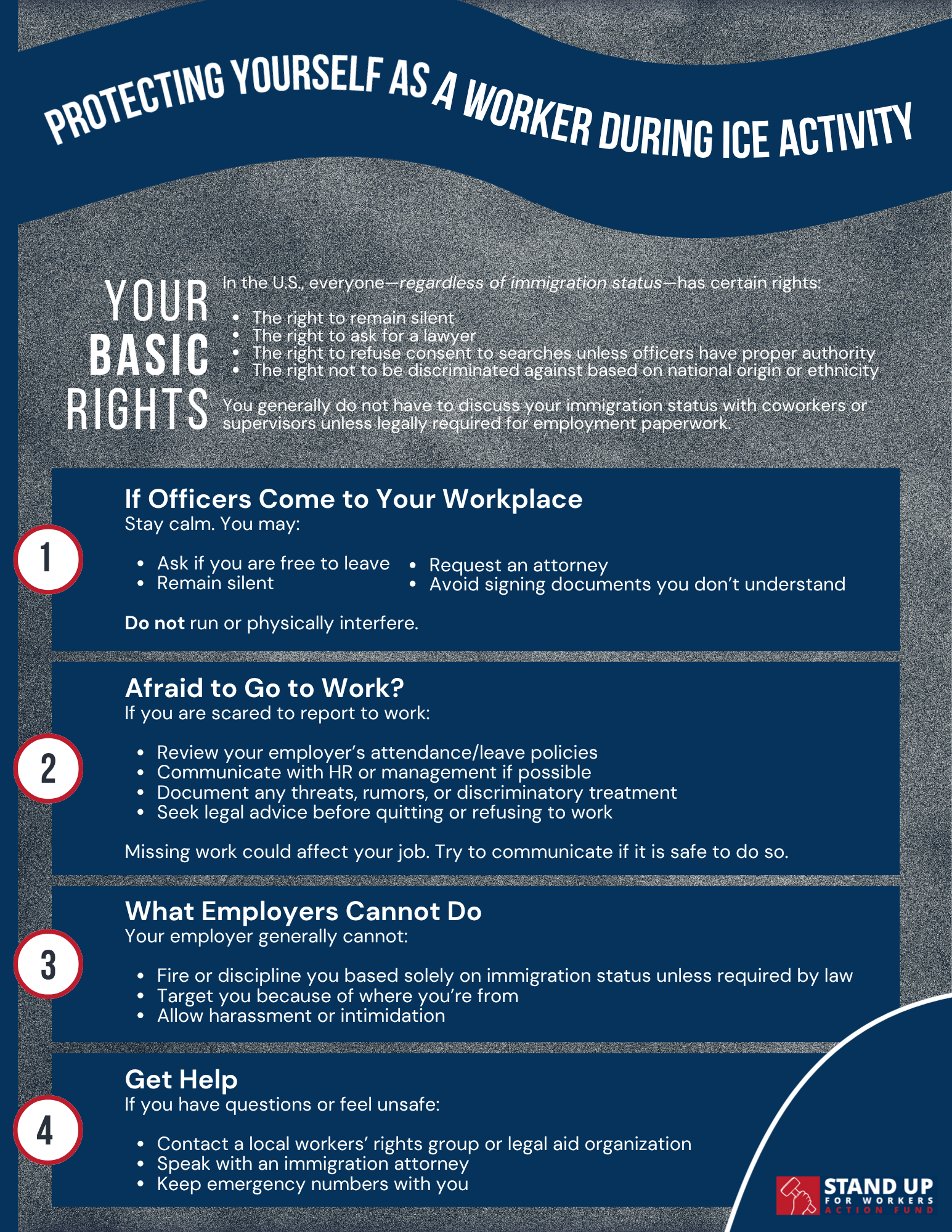
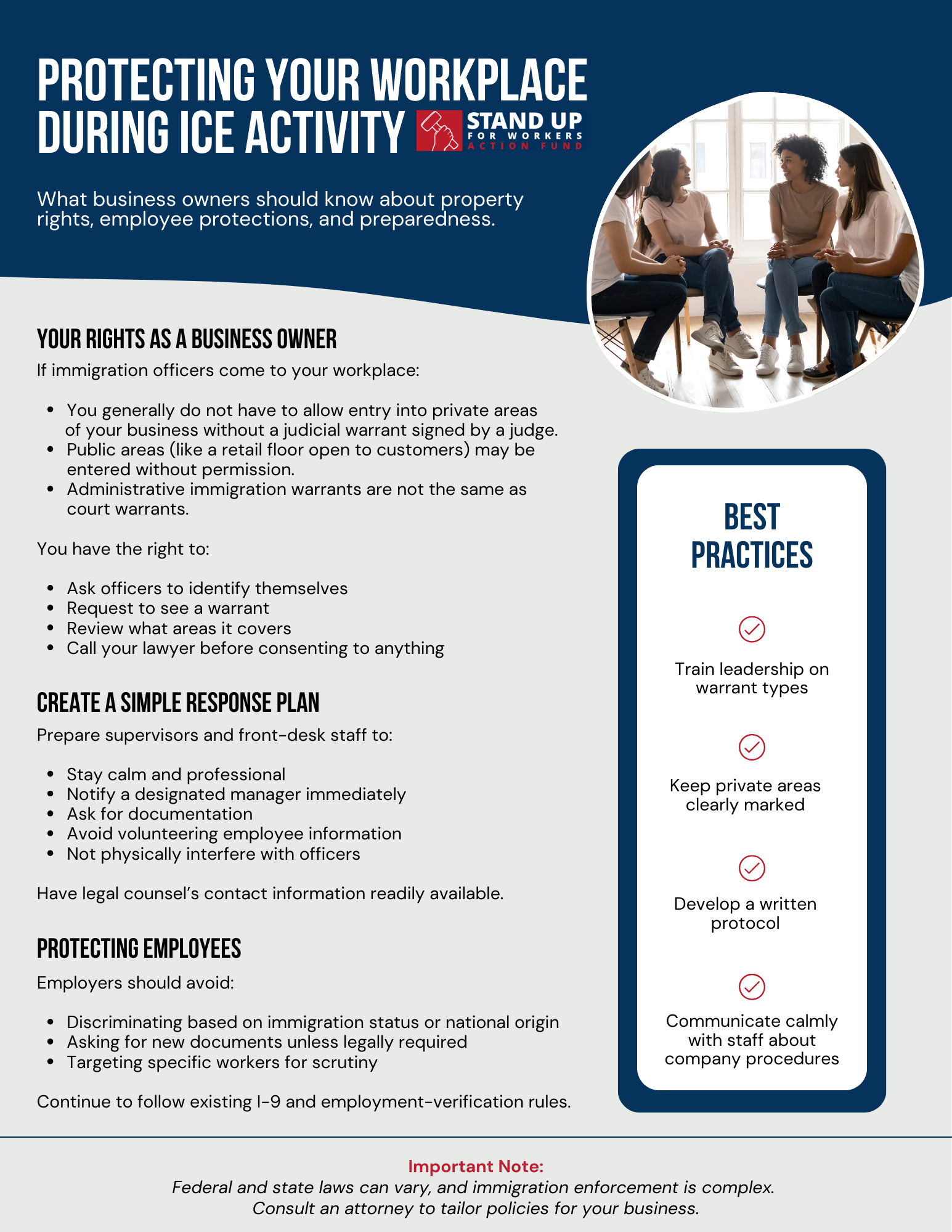
RESOURCE: Protecting Yourself During ICE Activity

In the U.S., everyone, regardless of immigration status, has certain rights. As ICE activity continues across U.S. cities, it’s important to know what these rights are. Consider sharing this resource with your network or in your workplace.

Note: This resource highlights federal rights. These may vary by city and state.

Oregon Campaign for Just Cause

On November 3, 2026, Oregon voters may have the opportunity to approve a fundamental revision in the employment laws of that state. That revision would reverse a doctrine that has been adopted in all but one American state, and that has been used to destroy labor unions, weaken the protections adopted by the Congress and the Oregon legislature, and impair the respect that American workers receive for the work they perform.

The doctrine has a name: employment at will. It was first articulated in a treatise on employment rights in 1877, written by a railroad lawyer, and it was soon adopted as part of the legal regime supporting the Industrial Revolution. The doctrine claims that every employment for an indefinite period of time – that is, virtually every job in America – can be terminated at the will of the employer, without a reason, at any time, with no right to recover damages. The prior rule was that every “hiring” would be for a period of one year.

The new doctrine of employment at will has been rejected by every other industrialized nation. In the U.S., only Montana and Puerto Rico require that every contract of employment can be terminated only for just cause. Under this doctrine, employees have no protection from being fired for arbitrary reasons, without any prior warning or prior discipline, even if they have worked effectively for their employers for years. Some employers have established policies and procedures that seem to promise fair treatment, but then state that those provisions are not contractual and cannot be the basis for a lawsuit.

According to a recent national survey of workers:

  • 69% of workers said their employment was terminated for no reason or for what they claimed to be an unfair reason
  • 75% of workers were fired without warning or any opportunity to improve their work performance

Workers routinely accept demeaning, unsafe or even dangerous working conditions to avoid being disciplined or fired:

  • 59% of workers have skipped work breaks
  • 57% of them have worked overtime when they would have preferred not to work
  • 44% of workers have put up with verbal abuse from a manager or supervisor
  • 35% of workers have worked under dangerous or unsafe conditions
  • 33% of them accepted less pay than what was owed to them

This affects the health and safety of workers. In order to avoid being disciplined:

  • 66% of workers have worked while sick or injured
  • 47% of them postponed medical care
  • 45% of them neglected important family responsibilities or events

Oregon Initiative 36, if adopted by the voters, would eliminate the doctrine of at will, and would restore the respect that Oregon workers deserve. It would require that all Oregon employees, other than seasonal employees and employees hired for a specific term, would have four rights:

A property right to employment. All Oregon employers could impose disciplinary procedures or discharge only based on (a) just cause and due process, and providing (b) a severance payment. Employers would need to provide notice and adequate training on work rules, apply those work rules reasonably and consistently, perform a sufficient and fair investigation, and discipline employees appropriately and proportionately.

A right to good faith notice. Employers would need to notify employees before disciplining or discharging them, inform them of the nature of the investigation and of the alleged facts, and complete any investigation within a reasonable amount of time.

A right to association. Employees would be entitled to representation before being required to answer questions. Interviews generally will be conducted during working hours.

A right to security. Employees will be entitled to severance pay from the date of hire, unless for a seasonal layoff.

A right to remedy. Employees shall have a private right of action to seek relief and compensation for severe disciplinary action without just cause, and to seek just compensation severance, including prevailing plaintiff attorney fees.

The proponents for Oregon Initiative 36 are now working to gather no less than 156,231 petition signatures to get that measure on the November 2026 ballot. Working with their allies in the labor union movement, Jobs with Justice, the National Employment Law Project, the Democratic Party of Oregon, Democratic Socialists of America and Democratic Socialists of America, they will be circulating petitions at events in Oregon and doing other canvassing in the next four months. That will include the No Kings marches on March 28, the Portland Rose Festival, sports events, county fairs, farmers’ markets, and every place that people come to gather and to enjoy the spring and early summer weather.

This initiative will have strong bipartisan support. Just-cause policies are supported by 66% of all workers, including by:

  • 61% of Republican workers
  • 66% of Democratic workers
  • 72% of independent workers

This point is worth repeating. We are living in a time of intense political polarization in the United States. 64% of voters feel that the American political system is too politically divided to solve the nation’s problems. 80% of all adults feel that members of the opposite political party not only disagree about plans and policies, but cannot agree on basic facts.

Nearly half of adults feel that members of the opposing political party are “downright evil.” In this climate, it is remarkable that nearly identical percentages of workers from both political parties support just-cause policies. In fact, support for this pro-worker measure is strongest among independents, not by political partisans! Those policies are supported by two-thirds of all workers!

You can donate funds to support this effort at www.OUJC.org/Give. Donations are not tax-deductible. We encourage you to support this important initiative.

Written By Barry Roseman, Stand Up For Workers Board Member

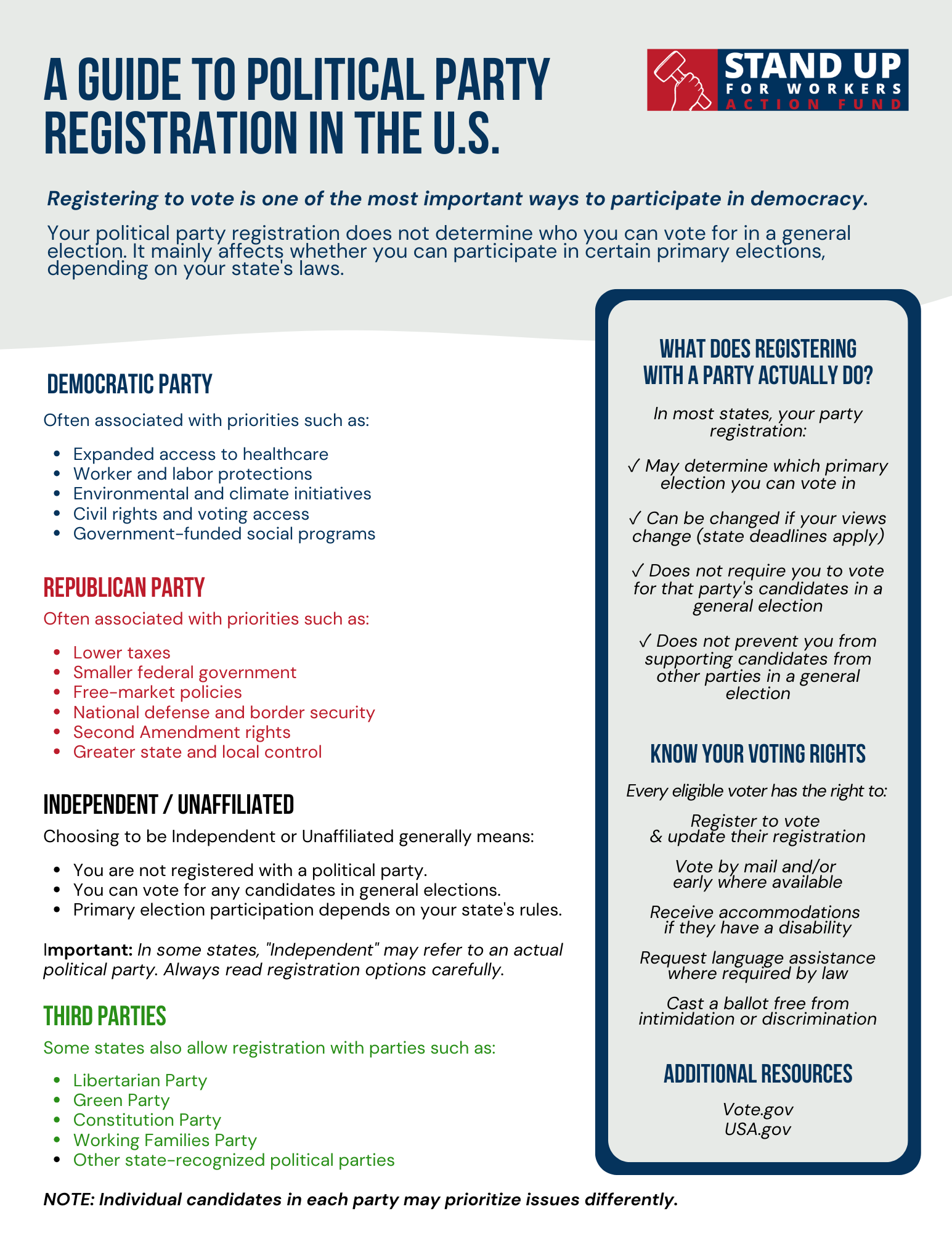
MAGA Strategy Appears Aimed at Overturning Defeat In Midterm Elections

As the November elections draw closer, statements and actions of the White House administration, along with pending legislation it has been pushing, offer clues as to the steps Trump supporters are contemplating as they seek to prevent the unfavorable results polls are predicting. A few mid-term losses could cost them their control of both houses of Congress.

Pres. Trump made a point, in his State of the Union address, to urge Congress to pass H.R. 7296, the Safeguard American Voter Eligibility Act, also called the SAVE Act. That bill would requires that states take affirmative steps to ensure that only U.S. citizens are registered to vote, including requiring documentary proof of citizenship; and establishing a program to identify individuals who are not U.S. citizens. Individuals seeking to vote in federal elections would be required to present an eligible photo identification document. The bill provides for criminal penalties for violations.

Most Americans do not have easy access to citizenship documents or photo IDs. Tens of millions of Americans lack ready access to election officials, during office hours. This bill, if enacted, would create a new poll tax that would disenfranchise those voters.

Another such legislative effort to restrict voting appears in H.R. 7300, the so-called “Make Elections Great Again Act.” Like the “SAVE” proposal, this bill would require photographic identification of would-be voters; and would require states to maintain voter registration forms. It repeals various existing voting support statutes, and substitutes the stricter barriers to participation.

These bills have no realistic chance of passing the Senate if Democrats filibuster them. Sen. John Cronyn, the Senate majority leader, opposes amending the filibuster rules to enable these bills to pass. That is because he knows that, if the Senate would do so, Democrats would be able to repeal these bills and to pass the much more progressive John Lewis Voting Rights without having to worry about a Republican filibuster.

Sen. Cornyn has threatened to force Democratic Senators to do a “talking filibuster,” that is, to take the floor of the Senate and to talk the bills to death. Senate Democrats are willing to take him up on that challenge, since virtually all of them oppose these bill.

In addition, the White House has taken actions that appear aimed at skewing or discrediting the results of the November elections should the election result in loss of that majority. First, the administration recently, for no readily apparent reason, successfully sought a judicial warrant requiring civilian election officials in Fulton County, Georgia, to turn over to the F.B.I. all ballots and tabulation materials relating to the 2020 presidential election. Despite repeated audits of these election returns showing that the White House occupant lost that election, he continues to repeat his lies claiming that he won.

Possession of the actual ballots used for that election will at this point not be likely to impact that result now five years in the past. But carrying out this seizure action will serve well as a dry run for taking similar actions in select districts this fall, should his favored candidates there lose. It should be a simple matter in that case, should the courts permit it, to seize the actual ballots used and, having exclusive access to them, take what steps are necessary to substitute a favorable, untrue result in favor of the chosen candidate.

This potential for preparing a strategy for replacing actual ballots with fabricated alternative papers favoring MAGA candidates offers a plausible rationale for the seizure of the 2020 ballots, which otherwise appears to have no realistic purpose.

In addition to this bizarre ballot seizure (which was supervised, in person, both by the director of national intelligence, whose functions are limited by law to international issues; and by the president himself), recent developments in the anti-immigrant campaign present additional aspects of the administration’s ongoing policy initiatives that could be used towards the same election-derailment end. As has been amply demonstrated in Minneapolis (as well as Los Angeles, Chicago and other locales) the administration now has at its beck and call a paramilitary organization, complete with uniforms, firearms, teargas, masks and badges, to implement its goals by force. These federal Immigration and Customs Enforcement (“I.C.E.”) agents, have shown a nearly complete lack of compassion, courtesy, professionalism or respect for the rights of other Americans or even any other humans, to say nothing of the rule of law.

These agents’ inclination towards unjustifiable violence has cost the lives of at least two U.S. citizens protesting in Minneapolis. Perhaps more troubling, their actions are chillingly reminiscent of another group, the SA or Sturmabteilung, which was active in assisting in the Nazi takeover of the German government in the 1930s. While arguably more extreme than the I.C.E. agents’ conduct, the SA harassed and attacked demonstrators opposing the Nazis, and killed a number of them.

These mask-wearing, law-breaking ICE agents, who are reportedly being assigned as security for American athletes at the winter Olympic games in Italy, could just as well be deployed broadly around the nation, to “guard” polling places in the fall elections. At the very least, their presence could be counted on to dissuade many voters who are aware of ICE’s reputation for violence even against citizens, sometimes leading to death; or who are leery of being seized and deported. Indeed, no less a figure than former adviser to the chief executive, and prominent MAGA activist Steve Bannon, as well as presidential spokesperson Karoline Leavitt, have been quoted saying that this use of the I.C.E. armed force is already under serious consideration. And the chief executive has stated publicly that “Republicans” should take over managing the election process come November.

The documented absence of serious voting irregularities in the U.S. means that the true motivation for these initiatives must lie elsewhere, and given the Republican fear of losses in November, restricting turnout of Democratic voters seems like a realistic possibility.

Under the U.S. Constitution, elections are to be managed by the states, meaning that these enactments could be subject to legal challenge if adopted. Moreover, despite favorable votes in the House, to get either or both of these bills passed in the Senate, Republicans would have to amend the filibuster rules, which, given Democratic opposition, it appears they will not attempt to do. Since 46 of the 47 Senate Democrats oppose both bills, the Democrats may be able to talk both bills to death; but the threat remains.

The fall elections are far away, and Republicans still have time to win back voters the traditional way, with positive responses to the most crucial issues, such as affordability and correcting the abuses of the immigration crackdown, However, their focus appears rather to be on changing the outcome by making burdening the process and reducing the numbers of voters. With the tools noted, including the ability to seize critical documentation at the heart of the election, and the powerful I.C.E. armed force, at its disposal, it is easy to see how the administration could anticipate overcoming even the serious opposition of many American voters to its policies and practices.

As encouraged as they may be by recent negative survey results for the White House occupant and his agenda, opponents of these attempts at distorting the upcoming elections must remain vigilant about protecting the true safeguards built into the process as it exists, including the freedom and independence of state and local election authorities. This vigilance must include continuing monitoring of efforts to tinker with the process, and to make changes likely to intimidate or discourage voters, including imposing federal requirements on, and restricting the autonomy of, local authorities. Such changes must be resisted vigorously by public statements and demonstrations, and by lawsuits if need be. While victory in a few districts in November could mean such opponents regain the majority, it requires only a similarly small number of victories to keep the present “Republican” majority in power.

Stratagems like those noted above could be all that is needed to prevent victory by the administration’s opponents. Failure to act to oppose and block those stratagems by any and all means may lead to the loss, permanently, of the key core mechanism of democratic government for this beloved country.

Written by Paul Merry, Stand Up For Workers Board Member

The ICE Surge In Minneapolis: COMING TO A CITY NEAR YOU!

It was a casual meeting.

At my health club in the beginning of February, a manager from one of Minneapolis’s major construction firms told me his company runs 22 crews across the metro. The day before, only four workers showed up. Four out of more than a hundred! Not because of weather. Not because of illness. Not because these workers were illegal. Because these workers were hiding in their homes too afraid of being swept up in the federal government’s immigration surge to go to work.

Their fear was not imagined. Thousands of immigrants have been detained in the Twin Cities since the start of Operation Metro Surge, and the vast majority should never have been taken in the first place. According to the University of Minnesota, roughly 75% were released because they were either U.S. citizens or have perfectly legal immigration status. Yet the damage is already done: the fear spread to everyone—documented and undocumented workers alike.

The economic fallout is visible across Minneapolis. Construction sites have slowed dramatically as migrant tradespeople, including those with legal status, stay home to avoid encounters with federal agents. Unions and contractors report that job-site visits by ICE have worsened an already tight labor market and delayed projects across the region. The broader workforce impact is staggering. A joint study by North Star Policy Action and the W.E. Upjohn Institute found that Twin Cities workers lost $106 million in wages between early January and mid-February. During that same period, the number of employees working in the metro fell, the number of operating business locations dropped and hours worked declined nearly 2%.

Small businesses—especially those serving immigrant communities—have been hit hardest.

One North Minneapolis grocer reported losing 90% of his business as both workers and customers stayed home, terrified that a routine errand could end in detention. His workforce shrank from 70 employees to 19. This is what happens when a federal crackdown treats an entire community as suspect. It doesn’t just target the undocumented. It freezes whole neighborhoods. It empties job sites. It drains paychecks. It punishes families who have every legal right to be here.

I’ve lived in Minneapolis since 1980. I know this city. I know its workers. I know its heart. What’s happening now is not who we are, and the people paying the price are the ones who have built, cleaned, cooked, cared for, and sustained this community for decades.

And this could be coming to a city near you!

Written By Jim Kaster, Board Chair of Stand Up For Workers

The Gavel and Your Paycheck: Why the Latest Judicial Nominations Matter for Every American Worker

Whether you are a barista, a middle manager, or a factory supervisor, you probably don’t spend your Tuesday mornings checking the federal judicial nomination list. It feels like “D.C. noise”—distant, political, and largely irrelevant to your daily shift.

But as a plaintiff’s lawyer in Austin, TX who fights for workers nationwide, I’m here to tell you: The person sitting behind that federal bench may have more power over your career than your own boss does.

And, the current administration is changing the game on judicial nominations and the face of the judiciary in a way that may harm workers’ rights for decades to come. As we start 2026, the rules of the game are changing, and politics is to blame. If you’ve ever dealt with employment law or care about these issues, the latest news from Washington should be on your radar.

Recent reports from Reuters confirm that the administration has launched into 2026 with four new judicial nominees, including Anna St. John, nominated to the U.S. District Court for the Eastern District of Louisiana (Reuters, Jan 7, 2026). St. John comes from the Hamilton Lincoln Law Institute, a group known for its “crusade” against class action settlements—the very tool workers use to band together when a company steals wages or discriminates on a mass scale.

This follows a year of rapid appointments aimed at reshaping the courts with younger, “originalist” judges. Some of these lifetime appointees have raised serious alarms. For instance, Whitney D. Hermandorfer, a 37-year-old nominee for the Sixth Circuit, has faced intense scrutiny for her lack of trial experience and her history as lead counsel defending restrictive state laws that intersect with worker privacy and health (Truthout, June 10, 2025).

At the same time, Bloomberg Law notes a significant change in how these nominees are being revealed. By bypassing traditional vetting periods—shrinking the window from the standard 28 days to as little as 48 hours for some nominees—the opportunity for regular citizens and legal experts to scrutinize these lifetime appointments has virtually vanished (Bloomberg Law, Nov 10, 2025).

Why does this matter to the average worker? Because these judges generally have a broad skepticism of worker protections and a deep-seated affinity for corporate autonomy. Furthermore, we are seeing a judiciary increasingly friendly to mandatory arbitration. You likely signed one of these in a stack of paperwork on your first day. It’s a clause that says if the company breaks the law, you can’t sue them in public court. Instead, you have to go to a private, secret hearing.

The 2025-26 nominees are largely pro-arbitration and anti-class action. This means that for the millions of Americans in retail, healthcare, and tech, the “right to a trial” is becoming a relic of the past. When judges refuse to strike down unfair arbitration clauses or make it impossible to file a class action, they effectively hand large corporations a “get out of jail free” card.

The law is only as strong as the person interpreting it. While 2026 brings new challenges for the American worker, it doesn’t mean you and I are powerless. It just means you have to be smarter, better prepared, and more involved than before.

Lifetime appointments mean these decisions will affect not just your current job, but your children’s jobs. We must use the ballot box and our collective voices to ensure that those who hold the gavel actually respect the rights of the people who do the work.

Written By Austin Kaplan, SU4W Board Member and Attorney at the Kaplan Law Firm, PLLC

Report from the Occupied City of Minneapolis: The Chilling Impact of ICE Operations

I am on the ground in Minneapolis, witnessing a city transformed by fear and uncertainty.

The killing of Renee Good occurred just minutes from my home and Alex Pretti just a few blocks further—a vivid reminder of the pervasive violence that now shadows even the most familiar corners of this beautiful, loving community. I have lived in this city since 1980. We pride ourselves on being a progressive, welcoming place, where diversity is celebrated and kindness is the norm. Today, that sense of safety and belonging feels far away.

The atmosphere here is heavy with anxiety. Many residents, particularly those from Hispanic backgrounds, are afraid to leave their homes, even for essential tasks like buying food. I am one of those old-fashioned people who still receive a daily paper at my door. Just this week I received a heartfelt letter from the Hispanic couple who delivers my newspaper, apologizing for missed deliveries out of fear for their safety. Their words echo the sentiments of countless others, including workers, students, and worshippers who now avoid workplaces, businesses, schools, and churches. The threat of ICE operations has cast a long, dark shadow over everyday life here, prompting many to stay indoors and isolate themselves from the community that we all love.

The local economy is also visibly suffering. Minority-owned businesses, once vibrant centers of commerce and culture, are now struggling as customers and employees alike stay away.  Widespread stories of raids and detentions have sent shockwaves through the business community, leading to reduced economic activity and loss of income for families dependent on these establishments. The ripple effect extends to schools and churches, where attendance has plummeted, further eroding the social fabric of our city.The current climate in Minneapolis evokes troubling historical parallels. The fear, the suspicion, the sense of being watched and hunted. These are not memories from another time and place, but realities faced by our community today. The indiscriminate nature of the operations here leaves no one untouched, and the psychological toll is immeasurable. It is unspeakable that such conditions exist in a city known for its openness and progressive values.

As if the social and economic challenges were not enough, Minneapolis is now gripped by the bitter cold of winter. The national news reported last night that the city streets were quiet.  Well, no kidding. It was 4 below zero. We are used to the cold, but combine that with ICE, and the effect on the community is unbearable.

Minneapolis is enduring an occupation of fear and uncertainty, its people held captive not just by ICE operations but by a loss of trust, security, a safe home and a stable workplace. Good people are afraid, and the damage to our community—socially, economically, and emotionally—is profound. It breaks my heart to see what is happening here.

Reliable reports place the percentage of undocumented immigrants in Minnesota at 1.5 percent. That’s right, 1.5 percent. Despite that low number, we are being targeted.  Minneapolis is a politically progressive city, the first district in the country to elect a Muslim representative to Congress. The relationship between our politics and the target on our back is unmistakable, and that should make us all consider where we are and what we need to do.

Written By James Kaster, Founder and Chair of Stand Up For Workers and Partner at Nichols Kaster in Minneapolis.

It’s 2026. Psychological Safety Is a Core Worker Right.

As 2026 begins, workers aren’t just tired. They’re carrying years of accumulated stress from instability, understaffing, and workplaces that demand resilience without offering protection. Burnout is no longer an individual issue. It’s a systems failure.

Psychological safety means more than feeling “comfortable” at work. It’s the ability to speak up about harm, set boundaries, report misconduct, and ask for support without fear of retaliation, dismissal, or being labeled “difficult.” For workers, it’s essential to health, dignity, and long-term participation in the workforce.

From a legal perspective, the foundation already exists. Workers have the right to a workplace free from harassment, discrimination, and retaliation under federal and state laws. Employers are required to engage in good-faith accommodation processes, protect whistleblowers, and address hostile work environments,  including those that cause psychological harm. Yet too often, these rights are under-communicated, inconsistently enforced, or framed as risks to manage rather than responsibilities to uphold.

A burnout-avoidant workplace starts with power-aware practices:

  • Clear, trusted systems for reporting concerns
  • Manager training that prioritizes accountability over control
  • Workloads that are realistic, humane, and transparent
  • Policies that explicitly protect mental health, leave, and accommodations

For advocates and workers alike, 2026 must be the year we stop individualizing burnout and start naming its root causes. Psychological safety is built when workers know their rights, trust that harm will be addressed, and believe they won’t be punished for telling the truth.

Cracks In MAGA’s Base Encourages Worker Advocates Preparing For Fall Elections

As the new year begins, the seemingly unending series of missteps by the current White House, especially on the economy, is feeding a growing number of defections of Trump loyalists away from their unbreakable bond to the chief executive.

This turn away from him, shown by recent polling, gives additional openings for worker advocates to return a pro-worker majority to Congress come November.

An NBC poll from last month reported a drop of 8 points among respondents “strongly” favoring the chief executive, down from a high of 78% in April. Such a support loss is significant considering the chief executive’s narrow margin of victory in 2024.  The same poll showed the percentage of “MAGA” Republicans has dropped from 57% in April to 50% last month.

The data shows voters increasingly disapprove of his handling of the economy, with just 26% believing Trump is doing a good job. The New York Times reported that as of January 2,  Trump’s disapproval rating was at 54%, compared with approval of 42%. Also, a majority of Americans, including one-third of Republicans,  now hold Trump more responsible than Biden for the economy.

Trump has also seen faltering numbers within his own party: only 75% of Republicans approved of his handling of the economy in November, down from 82% in July, according to Marquette University polling; and his approval rating among white, college-educated men dropped to 40% from 47% in June according to Fox News polling.  

The president has experienced several notable breaks with his MAGA base in recent months. Despite his resistance, the House approved legislation last month requiring the Justice Department to release documents detailing its investigation into Jeffrey Epstein. Trump endorsed the bill after it won enough Republican support to pass, however, his Department of Justice has still reportedly failed to produce some million additional pages.

Meanwhile, the Washington Post reports that leaders of the Republican “MAGA” wing, alienated by his obliviousness to the cost of living, are “checking out” on Trump. In effect, it reports that Trump has reneged on the most important promises he made to win MAGA votes, including halting cost of living and inflation increases, as well as his prioritizing of international affairs.

A recent Economist/YouGov poll (Nov. 28-Dec. 1) found Trump had a 38% approval rating and 57% disapproval rating, the seventh week in succession that his rating was a -15% or lower. He ends the year with 39% approval and 56% disapproval ratings in this poll, a downward trend since the start of his second term: 51% of respondents said the economy is getting worse.

Under a November poll by NPR/PBS/Marist, Democrats have an advantage headed into next year’s midterms, with 55% saying they were more likely to vote Democratic, compared to 41% saying they would vote Republican. 

Potentially more ominous for the administration, polls reflect disillusionment with the chief executive among some groups whose support was key to his victory.  Specifically, Hispanic and Latinx voters are reconsidering their choices, according to media interviews. This offers an answer to the question whether the favorable swing of these voters was a permanent or momentary realignment.

Pew Research Center polling reflects this change. Latinos have grown pessimistic since the 2024 presidential election. Most say their situation has worsened, and as Trump’s second term unfolds, Latinos are increasingly critical of his job performance and immigration/economic policies – key issues for Latino voters.

In a striking result, some 55% of Latinos feel “very strongly” that Trump has done a bad job as president, contrasted with 18% who feel “very strongly” the opposite. The same polling finds pessimism has spiked among Latinos. 68% of Hispanic adults say the situation in the U.S. is worse for Hispanics today than a year ago, the first time in the poll’s two-decade history that a majority said their situation deteriorated. 61% of U.S. Latinos said Trump’s policies worsened the economy, while roughly one-third struggled to pay for groceries, medical care, and housing.

Blunders committed in acting on policy fronts may help explain the rising disillusionment. As one example, the demolition of the White House East Wing, has been met with disapproval from a broad spectrum of voters in polls. Trump building a $400 million dollar gilded “ballroom” while increasing numbers of Americans have trouble feeding and housing their families cannot have assuaged voters’ economic disappointment.

The recent, and apparently misdirected, military strike in Nigeria, ostensibly to help Christian residents but landing in an overwhelmingly Muslim province, appears to be an attempt at shoring up failing support among fundamentalist Christians, and may betray concern among advisers about softening of support from this element of their base.  

The plethora of actions aimed at institutionalizing the racist and white supremacist attitudes of Trump and his key advisers, including Stephen Miller, may also offer a basis for worker advocates to energize other minority group members. Indeed, while polling shows support for the administration’s efforts to tighten the southern border, it also reflects negativity towards the efforts to remove immigrants generally. The New York Times reported in November that most Americans favor reforming the legal immigration process instead. Decisions to halt visiting rights and immigration application processing for nearly forty (largely Black or brown) nations can hardly comfort Americans with relatives there. This is particularly striking when contrasted with the widely publicized policy granting accelerated immigration processing to (white) South Africans.  

It is too soon to know the American public’s view of the latest international-law-breaking gambit: the raid to have U.S. troops apprehend Venezuela’s president, after conferring with U.S. oil companies. But, the often-stated goal of seeing these corporations take over oil production can hardly be expected to mollify Trump voters annoyed with his prioritization of international matters.

In sum, a worker advocate campaign strategy emphasizing the administration’s failure to address the crowning themes of improving economic conditions and immigration control should resonate with a wide range of voters come November. Careful attention to the specific issues most important in individual districts, combined with the general economic pain theme, offers promise of change that will make a difference for the workers on whom the economy truly depends.

Written By Paul Merry, SU4W Board Member

Year In Review: Trump’s 2025 Record on Employee Rights

Year In Review: Trump’s 2025 Record on Employee Rights

If you care about labor and employment law issues, you should down a stiff drink and then contemplate this incomplete list of Trump’s destruction of those rights during the first ten months of his second term: 

Employment discrimination 

  • Trump revoked Executive Order 11246, issued by Pres. Lyndon Johnson in 1965, which prohibits employment discrimination by federal government contractors. 
  • He instructed the Department of Justice to ensure that federal contractors and other private parties do not promote Diversity, Equity and Inclusion (“DEI”) programs, without defining just what is a DEI program. 
  • Elimination of DEI programs has resulted in a decline in the hiring of employees of color and of women, and it has increased the incidence of discrimination and bias in the workplace. 
  • He issued several executive orders claiming that there are only two genders and targeting trans people for unequal treatment in a variety of areas, including in the military, in prisons and in passports. 
  • He removed two commissioners and the general counsel of the Equal Employment Opportunity Commission (“EEOC”) without cause. 
  • The EEOC, under its new leadership, has dismissed all of its discrimination cases alleging bias against trans people, removed a rule that said that abortion-related restrictions constitute pregnancy discrimination, and has filed cases involving employees’ religious observances, with a particular focus on “eradicating anti-Christian bias.” 
  • The EEOC has dismissed cases alleging disparate-impact discrimination, that is, where a facially neutral practice has a disproportionately adverse effect on a protected class of employees. 
  • The EEOC has claimed that programs designed to train, mentor or sponsor employees because of their sex, race or national origin are discriminatory. 

U.S. Department of Labor 

  • Trump reduced the minimum wage for employees of federal contractors. 
  • The U.S. Department of Labor (“USDOL”) has proposed abolishing more than 60 regulations, including: 
  • Eliminating federal minimum wage and overtime protections for home health care workers. 
  • Providing that disabled employees can be paid a sub-minimum wage, depriving them of the same minimum wages enjoyed by other employees. 
  • Eliminating anti-retaliation protections for migratory farmworkers. 
  • Rescinding a rule that requires employers to provide seat belts in employer-provided transportation for farmworkers. 
  • Rescinding a rule that requires employers to provide adequate lighting at construction sites. 
  • Limiting the scope of the Occupational Safety and Health Administration’s general safety rule, that applies whenever no specific safety rule is in place. 
  • Stripping Mine Safety and Health Administration district managers of their authority to require mine owners to submit plans for ventilation and to prevent roof collapses in coal mines. 
  • The USDOL has stated that it will not enforce a Biden rule on when a worker is an independent contractor, and has stated that it will revise that rule in a deregulatory direction. 
  • The USDOL has informed an appellate court that it is considering revising a Biden rule that substantially increased coverage of the overtime provisions for salaried employees. 
  • The Trump administration has moved from expansive federal oversight of employment of minors to targeted enforcement and employer-led compliance of federal child labor laws. 
  • Trump has proposed repealing a USDOL policy that restricts 16- and 17-year-old employees from using powered patient lifting devices in nursing homes. 

National Labor Relations Board 

  • He removed the general counsel and one of the members of the National Labor Relations Board (“NLRB”), leaving only two members of that five-member board. 
  • As a result, the Board does not have a quorum and is not able to adjudicate cases, including complaints that employers have committed unfair employment practices. 
  • Trump effectively eliminated the Federal Mediation and Conciliation Service (“FMCS”), an agency that assisted in assisting employers and labor unions in the collective bargaining process. 

Federal Employees’ Rights 

  • Trump fired the chairwoman of the Federal Labor Relations Agency (“FLRA”), an agency that adjudicates disputes between federal agencies and labor unions. 
  • Trump excluded more than 1 million employees in more than 30 federal agencies from union representation. 
  • Trump fired the chair of the Merits Standards Protection Board (“MSPB”), a federal agency that hears appeals of federal employees’ disputes.  Combined with the resignation of another member, that action deprived the MSPB of a quorum for more than eight months. 
  • MSPB hearing officers, their numbers trimmed by budget cuts, are dealing with an overwhelming number of appeals, resulting in delays in resolving their cases.  
  • Trump revoked the federal labor-management forum program, which had enabled federal agencies and their employees to collaborate with each other. 
  • Trump attempted to narrow a Biden executive order that had required federal contractors to sign project labor agreements with subcontractors and associated unions. 
  • Trump fired the head of the Office of Special Counsel, an agency that is supposed to protect federal whistleblowers.  He then nominated Paul Ingrassia to fill that position. 
  • Ingrassia withdrew his nomination because, incredibly, he told a group of fellow Republicans in a text chain that the MLK, Jr., holiday should be “tossed into the seventh circle of hell” and that he has “a Nazi streak.” 

Layoffs of Federal Employees 

  • About 300,000 federal employees have been laid off. 
  • Trump accomplished this by stripping some federal employees of their federal protections, fired probationary employes, urged employees to resign, shut down agencies, implemented reductions in force, and claimed to layoff employees during the shutdown of the federal government. 
  • These layoffs are being contested in the courts, and many have been reversed.  The shutdown-related layoffs have been reversed by statute. 

Written By Barry Roseman, Secretary of the SU4W Board

2025 Special Elections Offer Encouragement For American Workers and Their Advocates

Riding a wave of resistance to the hard-right policies of Donald Trump’s Administration, Democratic candidates won decisively in every special election across the U.S. on November 4th.

Most notably, the election victories include:

  • the first woman to become governor of Virginia
  • a second woman governor candidate in New Jersey
  • a democratic socialist as mayor of New York City
  • California voters resoundingly endorsed a plan to counter mid-census gerrymandering in Texas by carrying out their own counter-gerrymandering
  • Democrats flipped two Public Service Commission seats in Georgia

And, three Pennsylvania Supreme Court justices were solidly retained in office despite a last-minute personal push by Trump to unseat them, bolstered by reportedly massive fundraising.

The Tuesday results exceeded predictions from pre-election polls in those states.  Before Tuesday’s election, an array of high-quality nationwide polling showed a distinct pattern of voter preference for policies and positions advanced by the Democratic party.  That included a well-respected poll which showed unaligned respondents indicating they are “leaning” Democratic by nearly a 10% margin.

Let’s talk numbers.

  • In traditionally blue New Jersey’s gubernatorial election, Democratic candidate Rep. and ex-Navy pilot Mikie Sherrill defeated Republican Jack Ciattarelli by a solid 9% margin, or 414,000 votes.  Arguably more significantly, in more purple Virginia, former Congresswoman and ex-CIA case analyst Abigail Spanberger garnered a nearly 15% margin of victory, carrying the state by more than 490,000 votes.
  • Also significant, Californians overwhelmingly adopted Gov. Gavin Newsom’s plan to counter Trump’s five-congressional-seat Texas gerrymandering scheme by 63% to 36%.  And the three Democratic justices on the Pennsylvania Supreme Court who were up for “retention” (unopposed) won by a margin of 61% to 36%, despite a last-minute surprise personal effort by Trump to turn out his supporters to remove them.
  • In the traditionally blue city of New York, candidate Zohran Mamdani defeated two other contenders, winning by 50% (to 41% for his closest competitor, Andrew Cuomo) of the ballots cast.

Analysts looking at the results opined that they represent an even greater shift away from the party in power than typically occurs in mid-term elections, and may signal a more fundamental shift in voter preferences, driven largely by sharply rising living costs.  Every single county in New Jersey, Virginia, Pennsylvania and Georgia moved toward Democrats.  The leading issues for voters for Sherrill and Spanberger were health care and the economy, and they won 93% of those economy-motivated voters.  Zohran Mamdani’s winning campaign in New York City was laser focused on affordability.

Elections in a few places outside the media spotlight also showed trending more towards Democrats, as reported by the newsletter Popular Information.  In a Georgia state-wide election, Democrats for the first time won seats on the state’s Public Service Commission.  In Pennsylvania’s largest “swing” county, Bucks, voters ousted the county’s Republican sheriff, who had signed a formal agreement that his department would collaborate with federal Immigration and Customs Enforcement programs and personnel.  In Mississippi, Democrat successes ended a thirteen-year Republican supermajority in the state Senate.  And in the third-largest school district inTexas, Cypress-Fairbanks Independent School District, progressive candidates won all three open board seats, giving them a 4-3 majority.  The prior Republican dominated board had removed books and chapters on climate change, vaccines, COVID-19 and diversity, and fired half of the district’s librarians.

These results reflected closely an array of polling numbers that shows that voter sentiment expressed in the November 4 vote is not limited to the states holding those elections, but is broadly shared by voters across the nation. An approval survey from late October, based on numbers from the aggregation site fiftyplusone.news, shows a continuing decline in approval for Trump since his inauguration. At that time his approval rating was 50% with a 40% disapproval rating; while current survey showed  disapproval by 55.3% compared to approval by 40.8%, a remarkable 14% decline in only nine months.  As our political analyst, Ian Silverii, pointed out, these numbers represent a weighted average of a variety of polls, which strengthens their credibility.  The disapproval level is also the largest yet for the president, even including the time during his first term when he was criticized for one million deaths of Americans due to COVID-19.

Mr. Silverii also reported on a high quality generic political poll showing Democrats ahead of Republicans by 3% percentage points.  He noted this poll is well regarded for predicting a party’s chances before an upcoming election.  Tuesday’s results, according to one analyst, predicts that Democrats will have an 8% generic advantage in 2026.

Mr. Silverii also pointed to a “leaned party ID” poll, which reports percentages of party identifiers and “leaners,” which showed that, for Quarter 3 of 2025, respondents leaning towards the Democratic Party outnumbered those inclined towards the Republican Party by 48% to 41% percent.  Those seeking further information about current voter inclinations might check CNN’s data guru, Harry Enten, who explains why the “leaning” poll matters.

In all, both the election results and his synthesis of nationwide polling data offer a solid basis for hope for supporters of American workers. With this encouragement, it appears clear that continuing, and greater, support for workers, through entities like the Stand Up for Workers PAC, have a better chance of success than many supporters have been anticipating. We look forward to working alongside advocates like you to ensure protections for workers continue to advance.


Written By Paul Merry, Stand Up For Workers Board Member

“It’s The Economy, Stupid!”

“It’s the economy, stupid,” said James Carville in 1992 when describing Bill Clinton’s winning economic message.

In 2024, Donald Trump was able to convince a small majority of Americans that he had a winning economic appeal, despite the Biden administration’s four-year recovery from the depths of the COVID-induced economic downturn in 2020 and 2021.  What was Trump’s economic appeal, how did it shape the election, and how he has delivered in the last ten months?

Trump promised in his 2024 campaign that his economic plans would lead to growth in the economy, while Kamala Harris’s economic message was based more on decreasing income inequality among the lowest-paid segments in this country.  The historic inflation rate was a major factor in the 2024 election – the price increases that had occurred in 2021 and 2022, even though price inflation in 2023 and 2024 was more moderate.  Many voters preferred Trump because he was a businessman who supposedly understood how to make the economy grow.

Trump’s economic program fell into five categories:

  1. reducing inflation
  2. including reducing the prices of groceries
  3. making the 2017 tax cuts permanent
  4. providing tax relief to the middle class
  5. increasing tariffs to increase manufacturing jobs in the United States

By nearly a two-to-one margin, voters said in exit polls that the economy was worse than it had been four years earlier.  One in four voters, including 41% of Black voters and 43% of Latino voters, said the economy was the primary reason for their vote.  And Harris received 7.1 million fewer votes in 2020 than Biden received in 2020, particularly in major urban counties.

The economy is now failing for ordinary hard-working citizens.  The percentage of long-term job seekers is now 26% of the total number of unemployed workers.  Delinquency rates for automobile loans are at a 15-year high.  The delinquency rates for office loans are at a rate approaching the peak in 2008, just before the Great Recession.  The most recent official inflation rate was at 3.0%, close to the annual high.  Many analysts expect that tariff rates will result in further increases in inflation, as exporters and importers reach a limit in the amount of price increases they can absorb.

The opposite is true for the upper reaches of the economy.  The stock market is at close to a record high.  Sales of luxury goods – principally eyewear, fashion, leather goods, watches and jewelry – in this country will increase by 3.6% this year.  The sales of luxury homes increased by 15.2% compared to one year ago.

This is already affecting Trump’s approval numbers.  According to realclearpolitics.com, a conservative-leaning website, Trump is now 13.4% under water in voter appraisals of his economic performance, and 25.3% under water concerning inflation.  Those polls show that 61.0% of voters disapprove and only 35.7% approve of his handling of inflation.  That trend is persistent over time and has gotten worse in recent months, with some recent polls showing 36% and even 42% disapproval numbers about inflation.

These economic and poll trends do not include voter disapproval of Trump’s anti-worker initiatives, from his attempts to reverse trends in decreasing inequality under the rubric of anti-DEI initiatives, to his efforts to deport millions of immigrants, to his efforts to roll back Department of Labor regulations, to his attacks on the federal workforce.

The mid-term elections are one year away.  If Trump’s economic- and inflation-based approval ratings continue to decline, Democrats could regain control of the U.S. House and possibly the Senate – if they have a positive message for America’s workers.  Democrats cannot just assume that an anti-Trump message will be enough.

Whether their critique is the one made by Ezra Klein and Derek Thompson in “Abundance,” or some other approach, Democrats need to overcome voters’ overall belief that Republicans are better than Democrats in growing the economy or in combatting income and wealth inequality.  Otherwise, Democratic voters will stay home in 2026, just as they did in 2024, and Trump will win by default.


Written By Barry Roseman, Stand Up For Workers Board Member

Elections: Looking Ahead and Voting For Change

With key races being won, we’re reminded that every ballot cast shapes the future of our rights.

For workers, the policies that protect fair wages, safe workplaces, and equal opportunity are decided at every level of government, from city council to Congress, making all elections over the next year critical.

This election season is about more than 2026. It’s about building the foundation for lasting change in 2028 and beyond. Staying informed, speaking up, and showing up to vote are some of the most basic and powerful ways we can safeguard our rights and demand a fairer, more just workplace and society for all. As we head into the holiday season, we encourage you to continue having conversations, bringing awareness, and showing up for our neighbors who continue to be heavily impacted by the current U.S. administration.

Looking ahead, we are still building momentum and identifying candidates that will make the highest impact on U.S. workers and their families. Have a candidate in your area that we should know about? Send an email to [email protected].

Stand Up For Workers PAC Board Members Selected as 2022 NELA Gala Awards Celebration Honorees

Stand Up For Workers PAC Board of Directors members Joseph Garrison of Garrison, Levin-Epstein, Fitzgerald & Pirrotti, P.C. and Menaka Fernando of Outten & Golden LLP have been selected as honorees at the 2022 NELA Gala Awards Celebration, which will take place on Saturday, July 2, 2022.

Don’t Discount Administrative Law: Chevron May Save Your Life

By Paul H. Merry

The surest way to win rolling eyes and deep groans from law students, and from many practicing lawyers, too, is to mention administrative law. The name alone evokes images of excruciatingly tedious and interminable forms, row on row of the Code of Federal Regulations stretching out as far as the eye can see on endless library shelves, and of oblivious bureaucrats so enmired in an odious process that they long ago lost sight of the purpose of their existence. 

But opponents of the latest past president’s determined attempts to undo and demolish years of careful regulation aimed at protecting the environment, consumer rights, and a host of other public interests, so that his billionaire cronies could become even more outrageously wealthy would be wise to bear in mind that they owe a huge debt to the much-maligned administrative law system. This highly evolved mix of constitutional, statutory, and decisional jurisprudence has been the principal, and most effective, impediment thus far to his efforts at destruction, protecting much of the regulatory system until he lost his bid for re-election. 

Contrary to the claims of anti-regulation, anti-government conservatives, issuing a regulation does not happen at the whim of a tree-hugger. Rather, no new regulation will succeed in the absence of scientific and experience-based demonstrations that it is necessary. The system of statutes and court decisions that make up the field of administrative law requires an extensive process, usually taking years before a regulation can be put in place. In addition to expert, scientific opinion and painstaking descriptions of the grounds giving rise to the proposed regulation, extensive public testimony from all interested parties form an important part of the record, without which a new regulation is unlikely to survive the judicial scrutiny to which it is more than likely to be subjected. 

As logic requires, the process for repealing existing regulations can be equally thorough. When regulations are supported by extensive scientific evidence, learned opinion, and public testimony, it would be irrational to repeal a regulation unless even more evidence support that repeal. This is one thing that the former president’s zealous anti-regulation minions appear never to have fully understood; and as a result, the massive assault on the carefully developed regulatory system bore but little fruit. 

This would be all well and good were not much of the administrative law system, as noted, decisional, judge-made law; and like other decisions, the decisions that have built the system can also be reversed if they come before judges so inclined. This reality throws into dramatic relief the importance of our judicial system being composed of jurists who understand and respect the importance of the administrative law system. And to assure that judges who share such respect are appointed, it is critical that the United States Senate, which is responsible for approving judges, contain a majority of senators who will stand behind that system. Which, of course, is where Stand Up For Workers Political Action Committee comes in: the funds we raise, through generous donors such as you, are directed only to senate candidates who share these values. 

One specific issue powerfully illustrates this point. Most Americans understand that under our three-branched democracy, the judicial branch of government acts as a check on the actions of the legislative and executive branches, holding their actions up to scrutiny for consonance with our Constitution. Since the early years of the republic, it has been clear that the courts are the branch that scrutinizes and interprets the statutes that Congress passes and the Executive signs. 

The administrative system, however, (which makes up the bulk of what most people think of as the government ) adds a few wrinkles to the process of checking and balancing. First, one of the principal justifications for the creation of the administrative agencies through which our government functions, is that many issues our government confronts, from water and air purity to reliability of investments to safety of air (and other) travel, to allocation of the radio-magnetic frequency spectrum, to consumer fairness in the marketplace, to wildlife management, requires great scientific understanding and expertise. And notwithstanding the settled notion that the courts are the branch empowered to determine the constitutionality of laws passed by Congress, empowering the courts to review and reject regulations that are based on extensive research and scientific investigation of issues of which judges may have next to no understanding, appears illogical if not foolish, particularly if it appears judges with a particular ideological bent may be involved. The question of whether courts could be compelled to abandon their law-interpreting, core function, and be required to defer to the judgment of expert scientific specialists in the agencies, was clearly seen as a challenge to the founding principles of our democracy. 

Several decades ago the Supreme Court took the bull by the horns and issued its famous decision in Chevron, U.S.A. v. Natural Res. Def. Council, 467 U.S. 837 (1984). In a Solomonic action that many find unsatisfactory even to this day, the High Court decreed that when the lower courts are confronted with a challenge to the regulation, they must apply a three-part test before assuming the authority to review, and possibly overturn an administrative agency action. First, lower courts must determine whether Congress “has spoken to the precise question at issue,” in the statute establishing the agency or elsewhere. If so, the inquiry ends, because the courts and agencies must “give effect to the unambiguously expressed intent of Congress.” If the statute is silent or ambiguous regarding the specific point, the court must then decide whether the agency interpretation is “based on a permissible construction of the statute.” If the statutes explicitly left a gap in a program, the agency’s filing of the gap by regulation must be upheld so long as it passes the standards of the Administrative Procedure Act, including not being arbitrary, capricious, or contrary to the statute. Unless the agency action clearly fails to pass the first two steps, the court must defer to the agency’s expertise and decline to overturn the questioned action. 

Many critics of this approach have pointed out that the reliance on the court to determine whether the agency’s interpretation of the statute is “permissible,” to set the boundaries of court deference is hardly clear and certain. But this criticism is somewhat laid to rest on the basis of extensive jurisprudence defining the word and how it is to be used. And beyond this, of course, is a now-lengthy history of courts using the Chevron mechanism successfully. The more serious problem is the mechanism itself. However unsatisfying its language may be, the Chevron test has stood for decades now as a bulwark against the wanton destruction of painstakingly developed regulations in many crucial areas of American life, some of which are listed above. But as with any judge-made law, the mechanism can be overruled and consigned to the (famously vast) judicial scrap heap. 

Indeed, one recent appointee to the Supreme Court has been accused of being a Chevron opponent. And given the ideological stance (unfortunately) adopted by others on the Court, that opponent, Justice Kavanaugh, could find a majority to overturn Chevron and replace it with a much less regulation-neutral position, liberating lower court judges so inclined to lay waste at will to the regulations Americans have come to take for granted as they assume the safety of their food and drugs, their air and water, their airplanes and countless other features which make modern life so wonderful. And with a concerted (and largely successful) effort to place anti-regulation ideologues on the bench during the past administration, such freedom would almost certainly be widely exercised. 

So again, it is important to assure that judges named to lifetime positions on our federal courts are not hostile to the Chevron doctrine; and the way to do that is to be vigilant about nominating and electing senators who likewise support the government’s role in assuring that the technological wonders that permit us to live in a world beyond the dreams of our forebears are safe and not inviting the death of the only planet we have for a home. And while the role of money in politics is certainly open to criticism as now practiced, those donations made to Stand Up For Workers will be used in their entirety to support the process of vetting candidates for those senate seats, letting the public know their positions, and assisting those who meet our criteria to the greatest possible extent. So please give generously. Your country requires no less.

Key Takeaways From Voter Suppression In 2020 By William Wilder, Published By The Brennan Center For Justice

By J. Arthur Smith, III

INTRODUCTION  

“In the 2020 election cycle, voter suppression was alive and well. Overall, 70.9 percent of eligible white voters cast ballots in 2020 elections, compared with only 58.4 percent of non-white voters. . . After the 2010 elections, for the first time since the peak of the Jim Crow era, states across the country began to enact laws making it more difficult for certain segments of population to vote. This wave of voter suppression was intertwined with race and the nation’s changing racial demographics and was, in least in part, backlash against rising turnout among communities of color contributing to the election of the nation’s first Black president. Efforts to suppress the votes of communities of color accelerated in 2013, when the Supreme Court gutted a key part of the  Voting Rights Act in Shelby County v. Holder, 570 U.S. 529 (2013). In the eight years since Shelby  County was decided, especially in 2020, these trends continued.” (p. 3) 

In Shelby County v. Holder, supra, the United States Supreme Court declared unconstitutional the formula for the selection of states to be covered by § 4(b) of the Voting Rights  Act of 1965. As a result, § 5 was immobilized. Sections 4(b) and 5 required pre-clearance federal approval of changes in voting laws in the covered jurisdictions. Under the Act, “a change will be  approved unless Department of Justice finds it has the purpose [or]. . . the effect of denying or  abridging the right to vote on account of race or color.” 

“Racial discrimination voting takes many forms, ranging from blatant and open attempts to restrict access to voting among communities of color to more subtle policies that place heavier

burdens on certain communities. In 2020, voters of color faced a full spectrum of racial voter  suppression.” (p. 3) 

“. . .the public officials and political operatives behind these voting changes are  acknowledging that the intent of the new laws and policies is to exclude certain people from the  electorate and bring about particular outcomes in elections.” (p. 3) 

“When defending two of Arizona’s restrictive voting laws before the United States  Supreme Court on March 2021, the attorney for the Republican National Committee admitted that  the party’s interest in the laws was to avoid being at a “competitive disadvantage relative to  Democrats.” And when discussing proposals to expand access to mail voting, former President  Trump stated that an expansion of early and mail voting would lead to “levels of voting that if you agreed to it, you’d never have a Republican elected in this country again.” (p. 3). Similarly, Senator  Lindsey Graham stated that if “Republicans don’t challenge and change the U.S. election system  there will never be another Republican president elected again.”

Read the entire article here.