Trump’s War On Iran Will Add to American Workers’ Economic Woes

American workers, already whipsawed by the effects of Trump’s capricious tariffs and other uncertainties of the economy, are likely to be the group most adversely impacted by the war against Iran according to labor economists and other economic analysts. 

Such effects include:

1. Jobs, Hiring, and Economic Stability

While direct job losses are hard to predict, the indirect effects are clearer and concerning. If the conflict drags on, consumer spending may fall, businesses may slow hiring, and layoffs could follow.

A major disruption is already underway: the near shutdown of oil tankers through the Strait of Hormuz, a critical passage for roughly 20% of global petroleum shipments. Oil prices jumped nearly 10% after the conflict began, raising costs across industries from shipping to manufacturing.

This threatens a fragile recovery in U.S. manufacturing. Rising input costs for energy, materials, and transportation are already surging at their fastest pace in years. As production becomes more expensive, companies may scale back operations, cut hours, or reduce their workforce.

Supply chain vulnerabilities extend beyond oil. For example, a prolonged closure of the Strait could choke off a significant portion of the world’s helium supply—critical for semiconductors, medical equipment like MRI machines, and defense technologies—putting additional jobs at risk.

At the same time, the growing reliance on digital infrastructure leaves businesses exposed to cyberattacks. Iran and its allies have historically used cyber warfare in response to military conflict, and disruptions could halt business operations, threatening jobs across sectors.

2. Rising Costs for Everyday Life

Workers will also feel the impact at homeespecially through rising energy and food costs.

Gasoline and diesel prices are expected to climb, along with electricity costs driven by higher natural gas prices. These increases hit lower-income workers hardest, particularly those with long commutes, as more of their income is diverted to basic transportation.

Food prices (already a straincould rise further. Higher fuel costs increase the price of transporting goods, while disruptions to fertilizer supplies (much of which originates from the Persian Gulf) could reduce agricultural output. The result: higher grocery bills and tighter household budgets.

3. Long-Term Outlook for Workers

Unlike past wars, this conflict may not produce a significant boost in employment. Advances in technology like drones and automation reduce the need for human labor even during wartime production.

History offers a cautionary note: labor shortages can sometimes strengthen workers’ bargaining power, but they can also accelerate automation, ultimately reducing jobs.

Meanwhile, financial markets are already reacting. Rising energy prices and uncertainty have triggered declines in major stock indexes. If the conflict continues, economists warn of a broader slowdown. Businesses may pull back on hiring or cut jobs altogetherraising the risk of a recession.

As one economist put it, without a clear exit strategy, the economic effects of this conflict could be long-lastingleaving American workers to bear much of the burden.


Written By Paul Merry, SU4W Board Member

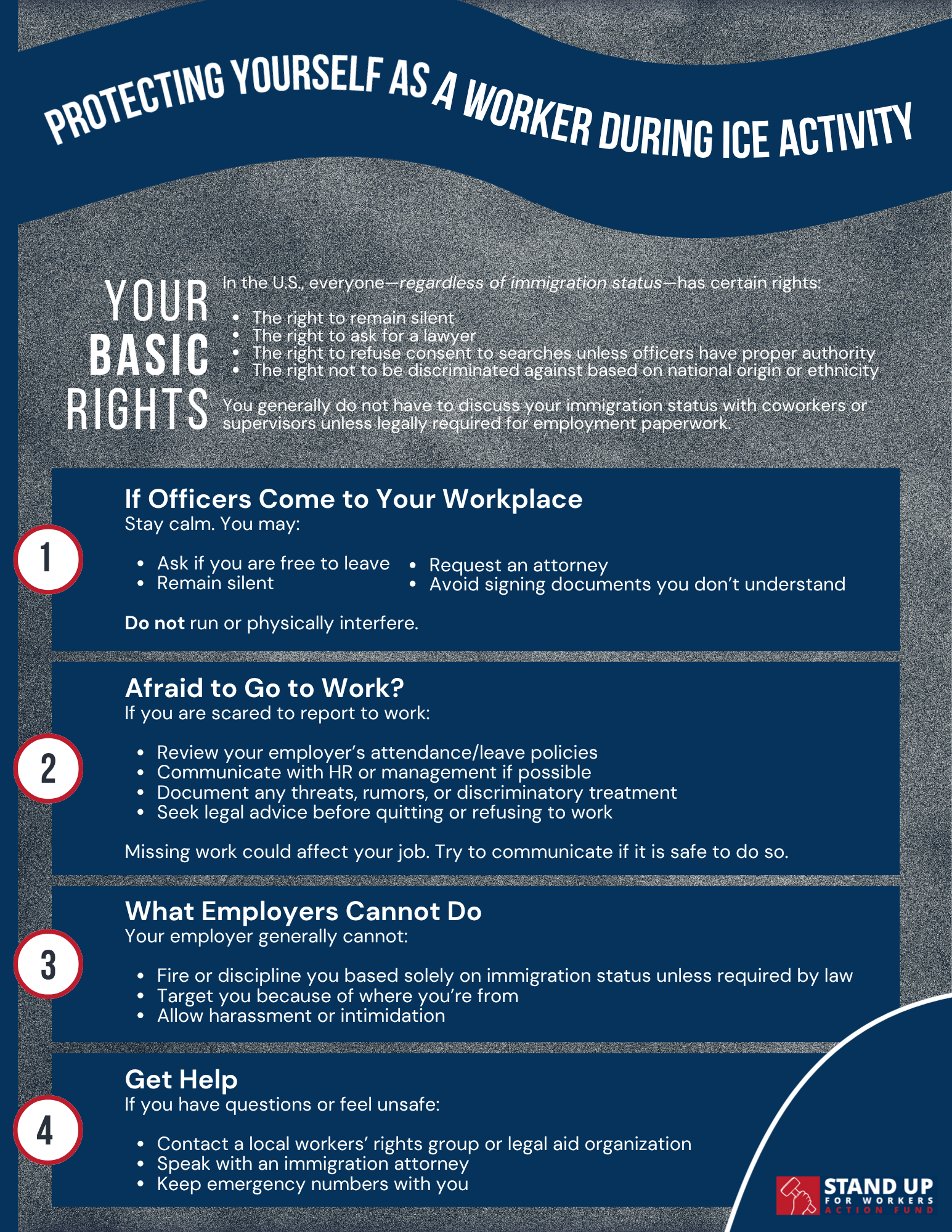
RESOURCE: Protecting Yourself During ICE Activity

In the U.S., everyone, regardless of immigration status, has certain rights. As ICE activity continues across U.S. cities, it’s important to know what these rights are. Consider sharing this resource with your network or in your workplace.

Note: This resource highlights federal rights. These may vary by city and state.

Oregon Campaign for Just Cause

On November 3, 2026, Oregon voters may have the opportunity to approve a fundamental revision in the employment laws of that state. That revision would reverse a doctrine that has been adopted in all but one American state, and that has been used to destroy labor unions, weaken the protections adopted by the Congress and the Oregon legislature, and impair the respect that American workers receive for the work they perform.

The doctrine has a name: employment at will. It was first articulated in a treatise on employment rights in 1877, written by a railroad lawyer, and it was soon adopted as part of the legal regime supporting the Industrial Revolution. The doctrine claims that every employment for an indefinite period of time – that is, virtually every job in America – can be terminated at the will of the employer, without a reason, at any time, with no right to recover damages. The prior rule was that every “hiring” would be for a period of one year.

The new doctrine of employment at will has been rejected by every other industrialized nation. In the U.S., only Montana and Puerto Rico require that every contract of employment can be terminated only for just cause. Under this doctrine, employees have no protection from being fired for arbitrary reasons, without any prior warning or prior discipline, even if they have worked effectively for their employers for years. Some employers have established policies and procedures that seem to promise fair treatment, but then state that those provisions are not contractual and cannot be the basis for a lawsuit.

According to a recent national survey of workers:

  • 69% of workers said their employment was terminated for no reason or for what they claimed to be an unfair reason
  • 75% of workers were fired without warning or any opportunity to improve their work performance

Workers routinely accept demeaning, unsafe or even dangerous working conditions to avoid being disciplined or fired:

  • 59% of workers have skipped work breaks
  • 57% of them have worked overtime when they would have preferred not to work
  • 44% of workers have put up with verbal abuse from a manager or supervisor
  • 35% of workers have worked under dangerous or unsafe conditions
  • 33% of them accepted less pay than what was owed to them

This affects the health and safety of workers. In order to avoid being disciplined:

  • 66% of workers have worked while sick or injured
  • 47% of them postponed medical care
  • 45% of them neglected important family responsibilities or events

Oregon Initiative 36, if adopted by the voters, would eliminate the doctrine of at will, and would restore the respect that Oregon workers deserve. It would require that all Oregon employees, other than seasonal employees and employees hired for a specific term, would have four rights:

A property right to employment. All Oregon employers could impose disciplinary procedures or discharge only based on (a) just cause and due process, and providing (b) a severance payment. Employers would need to provide notice and adequate training on work rules, apply those work rules reasonably and consistently, perform a sufficient and fair investigation, and discipline employees appropriately and proportionately.

A right to good faith notice. Employers would need to notify employees before disciplining or discharging them, inform them of the nature of the investigation and of the alleged facts, and complete any investigation within a reasonable amount of time.

A right to association. Employees would be entitled to representation before being required to answer questions. Interviews generally will be conducted during working hours.

A right to security. Employees will be entitled to severance pay from the date of hire, unless for a seasonal layoff.

A right to remedy. Employees shall have a private right of action to seek relief and compensation for severe disciplinary action without just cause, and to seek just compensation severance, including prevailing plaintiff attorney fees.

The proponents for Oregon Initiative 36 are now working to gather no less than 156,231 petition signatures to get that measure on the November 2026 ballot. Working with their allies in the labor union movement, Jobs with Justice, the National Employment Law Project, the Democratic Party of Oregon, Democratic Socialists of America and Democratic Socialists of America, they will be circulating petitions at events in Oregon and doing other canvassing in the next four months. That will include the No Kings marches on March 28, the Portland Rose Festival, sports events, county fairs, farmers’ markets, and every place that people come to gather and to enjoy the spring and early summer weather.

This initiative will have strong bipartisan support. Just-cause policies are supported by 66% of all workers, including by:

  • 61% of Republican workers
  • 66% of Democratic workers
  • 72% of independent workers

This point is worth repeating. We are living in a time of intense political polarization in the United States. 64% of voters feel that the American political system is too politically divided to solve the nation’s problems. 80% of all adults feel that members of the opposite political party not only disagree about plans and policies, but cannot agree on basic facts.

Nearly half of adults feel that members of the opposing political party are “downright evil.” In this climate, it is remarkable that nearly identical percentages of workers from both political parties support just-cause policies. In fact, support for this pro-worker measure is strongest among independents, not by political partisans! Those policies are supported by two-thirds of all workers!

You can donate funds to support this effort at www.OUJC.org/Give. Donations are not tax-deductible. We encourage you to support this important initiative.

Written By Barry Roseman, Stand Up For Workers Board Member

MAGA Strategy Appears Aimed at Overturning Defeat In Midterm Elections

As the November elections draw closer, statements and actions of the White House administration, along with pending legislation it has been pushing, offer clues as to the steps Trump supporters are contemplating as they seek to prevent the unfavorable results polls are predicting. A few mid-term losses could cost them their control of both houses of Congress.

Pres. Trump made a point, in his State of the Union address, to urge Congress to pass H.R. 7296, the Safeguard American Voter Eligibility Act, also called the SAVE Act. That bill would requires that states take affirmative steps to ensure that only U.S. citizens are registered to vote, including requiring documentary proof of citizenship; and establishing a program to identify individuals who are not U.S. citizens. Individuals seeking to vote in federal elections would be required to present an eligible photo identification document. The bill provides for criminal penalties for violations.

Most Americans do not have easy access to citizenship documents or photo IDs. Tens of millions of Americans lack ready access to election officials, during office hours. This bill, if enacted, would create a new poll tax that would disenfranchise those voters.

Another such legislative effort to restrict voting appears in H.R. 7300, the so-called “Make Elections Great Again Act.” Like the “SAVE” proposal, this bill would require photographic identification of would-be voters; and would require states to maintain voter registration forms. It repeals various existing voting support statutes, and substitutes the stricter barriers to participation.

These bills have no realistic chance of passing the Senate if Democrats filibuster them. Sen. John Cronyn, the Senate majority leader, opposes amending the filibuster rules to enable these bills to pass. That is because he knows that, if the Senate would do so, Democrats would be able to repeal these bills and to pass the much more progressive John Lewis Voting Rights without having to worry about a Republican filibuster.

Sen. Cornyn has threatened to force Democratic Senators to do a “talking filibuster,” that is, to take the floor of the Senate and to talk the bills to death. Senate Democrats are willing to take him up on that challenge, since virtually all of them oppose these bill.

In addition, the White House has taken actions that appear aimed at skewing or discrediting the results of the November elections should the election result in loss of that majority. First, the administration recently, for no readily apparent reason, successfully sought a judicial warrant requiring civilian election officials in Fulton County, Georgia, to turn over to the F.B.I. all ballots and tabulation materials relating to the 2020 presidential election. Despite repeated audits of these election returns showing that the White House occupant lost that election, he continues to repeat his lies claiming that he won.

Possession of the actual ballots used for that election will at this point not be likely to impact that result now five years in the past. But carrying out this seizure action will serve well as a dry run for taking similar actions in select districts this fall, should his favored candidates there lose. It should be a simple matter in that case, should the courts permit it, to seize the actual ballots used and, having exclusive access to them, take what steps are necessary to substitute a favorable, untrue result in favor of the chosen candidate.

This potential for preparing a strategy for replacing actual ballots with fabricated alternative papers favoring MAGA candidates offers a plausible rationale for the seizure of the 2020 ballots, which otherwise appears to have no realistic purpose.

In addition to this bizarre ballot seizure (which was supervised, in person, both by the director of national intelligence, whose functions are limited by law to international issues; and by the president himself), recent developments in the anti-immigrant campaign present additional aspects of the administration’s ongoing policy initiatives that could be used towards the same election-derailment end. As has been amply demonstrated in Minneapolis (as well as Los Angeles, Chicago and other locales) the administration now has at its beck and call a paramilitary organization, complete with uniforms, firearms, teargas, masks and badges, to implement its goals by force. These federal Immigration and Customs Enforcement (“I.C.E.”) agents, have shown a nearly complete lack of compassion, courtesy, professionalism or respect for the rights of other Americans or even any other humans, to say nothing of the rule of law.

These agents’ inclination towards unjustifiable violence has cost the lives of at least two U.S. citizens protesting in Minneapolis. Perhaps more troubling, their actions are chillingly reminiscent of another group, the SA or Sturmabteilung, which was active in assisting in the Nazi takeover of the German government in the 1930s. While arguably more extreme than the I.C.E. agents’ conduct, the SA harassed and attacked demonstrators opposing the Nazis, and killed a number of them.

These mask-wearing, law-breaking ICE agents, who are reportedly being assigned as security for American athletes at the winter Olympic games in Italy, could just as well be deployed broadly around the nation, to “guard” polling places in the fall elections. At the very least, their presence could be counted on to dissuade many voters who are aware of ICE’s reputation for violence even against citizens, sometimes leading to death; or who are leery of being seized and deported. Indeed, no less a figure than former adviser to the chief executive, and prominent MAGA activist Steve Bannon, as well as presidential spokesperson Karoline Leavitt, have been quoted saying that this use of the I.C.E. armed force is already under serious consideration. And the chief executive has stated publicly that “Republicans” should take over managing the election process come November.

The documented absence of serious voting irregularities in the U.S. means that the true motivation for these initiatives must lie elsewhere, and given the Republican fear of losses in November, restricting turnout of Democratic voters seems like a realistic possibility.

Under the U.S. Constitution, elections are to be managed by the states, meaning that these enactments could be subject to legal challenge if adopted. Moreover, despite favorable votes in the House, to get either or both of these bills passed in the Senate, Republicans would have to amend the filibuster rules, which, given Democratic opposition, it appears they will not attempt to do. Since 46 of the 47 Senate Democrats oppose both bills, the Democrats may be able to talk both bills to death; but the threat remains.

The fall elections are far away, and Republicans still have time to win back voters the traditional way, with positive responses to the most crucial issues, such as affordability and correcting the abuses of the immigration crackdown, However, their focus appears rather to be on changing the outcome by making burdening the process and reducing the numbers of voters. With the tools noted, including the ability to seize critical documentation at the heart of the election, and the powerful I.C.E. armed force, at its disposal, it is easy to see how the administration could anticipate overcoming even the serious opposition of many American voters to its policies and practices.

As encouraged as they may be by recent negative survey results for the White House occupant and his agenda, opponents of these attempts at distorting the upcoming elections must remain vigilant about protecting the true safeguards built into the process as it exists, including the freedom and independence of state and local election authorities. This vigilance must include continuing monitoring of efforts to tinker with the process, and to make changes likely to intimidate or discourage voters, including imposing federal requirements on, and restricting the autonomy of, local authorities. Such changes must be resisted vigorously by public statements and demonstrations, and by lawsuits if need be. While victory in a few districts in November could mean such opponents regain the majority, it requires only a similarly small number of victories to keep the present “Republican” majority in power.

Stratagems like those noted above could be all that is needed to prevent victory by the administration’s opponents. Failure to act to oppose and block those stratagems by any and all means may lead to the loss, permanently, of the key core mechanism of democratic government for this beloved country.

Written by Paul Merry, Stand Up For Workers Board Member

Alaska’s Voice for Workers: Mary Peltola in Senate

Former representative Mary Peltola has consistently proven that “working-class values” are more than just a campaign slogan. They are a way of life.

As she officially launches her 2026 bid for the U.S. Senate, her campaign is gaining momentum as a champion for the people who keep Alaska running. The Stand Up For Workers PAC is considering supporting Peltola’s candidacy because she has remained steadfastly focused on “Fish, Family, and Freedom,” to prioritize local livelihoods.

Peltola has described herself as “the pro-fish, pro-choice representative for Alaska in Congress.” She was the first Alaska Native to ever serve in Congress, and was the first Alaska-born representative to serve that state in the U.S. House.

Peltola’s record in the House is a testament to her “worker-forward” approach. She famously stood her ground as one of only eight House Democrats to vote against a rail contract that lacked guaranteed paid sick days, choosing worker dignity over political expediency. Beyond the halls of Congress, she has been a driving force for Alaskans, securing over $2 billion in federal infrastructure funding and advocating for projects like the Willow Project, which is slated to create thousands of union-backed jobs. As a co-sponsor of the PRO Act, she has fought to dismantle barriers to collective bargaining, ensuring that laborers and tradespeople have a true seat at the table.

She describes herself as being “pro-fish” because, when she was growing up, with salmon fishing in the summers and dog mushing in the winters, Alaska was a place of abundance. She sees multi-national companies trawling Alaska’s waters and decimating its fish stocks. Grocery prices are rising, and the Trump administration is doing nothing to solve these problems.

The 2026 midterm elections will be a defining moment for the American worker, and we need to amplify leaders who refuse to compromise on labor rights and economic fairness. We invite you to join the fight and help us back champions like Mary Peltola, who understand the reality of Alaskan and American life.

Consider making a donation to the Stand Up For Workers PAC this month to help us provide the resources necessary to win tough races and elevate worker-focused candidates across the country.

The ICE Surge In Minneapolis: COMING TO A CITY NEAR YOU!

It was a casual meeting.

At my health club in the beginning of February, a manager from one of Minneapolis’s major construction firms told me his company runs 22 crews across the metro. The day before, only four workers showed up. Four out of more than a hundred! Not because of weather. Not because of illness. Not because these workers were illegal. Because these workers were hiding in their homes too afraid of being swept up in the federal government’s immigration surge to go to work.

Their fear was not imagined. Thousands of immigrants have been detained in the Twin Cities since the start of Operation Metro Surge, and the vast majority should never have been taken in the first place. According to the University of Minnesota, roughly 75% were released because they were either U.S. citizens or have perfectly legal immigration status. Yet the damage is already done: the fear spread to everyone—documented and undocumented workers alike.

The economic fallout is visible across Minneapolis. Construction sites have slowed dramatically as migrant tradespeople, including those with legal status, stay home to avoid encounters with federal agents. Unions and contractors report that job-site visits by ICE have worsened an already tight labor market and delayed projects across the region. The broader workforce impact is staggering. A joint study by North Star Policy Action and the W.E. Upjohn Institute found that Twin Cities workers lost $106 million in wages between early January and mid-February. During that same period, the number of employees working in the metro fell, the number of operating business locations dropped and hours worked declined nearly 2%.

Small businesses—especially those serving immigrant communities—have been hit hardest.

One North Minneapolis grocer reported losing 90% of his business as both workers and customers stayed home, terrified that a routine errand could end in detention. His workforce shrank from 70 employees to 19. This is what happens when a federal crackdown treats an entire community as suspect. It doesn’t just target the undocumented. It freezes whole neighborhoods. It empties job sites. It drains paychecks. It punishes families who have every legal right to be here.

I’ve lived in Minneapolis since 1980. I know this city. I know its workers. I know its heart. What’s happening now is not who we are, and the people paying the price are the ones who have built, cleaned, cooked, cared for, and sustained this community for decades.

And this could be coming to a city near you!

Written By Jim Kaster, Board Chair of Stand Up For Workers