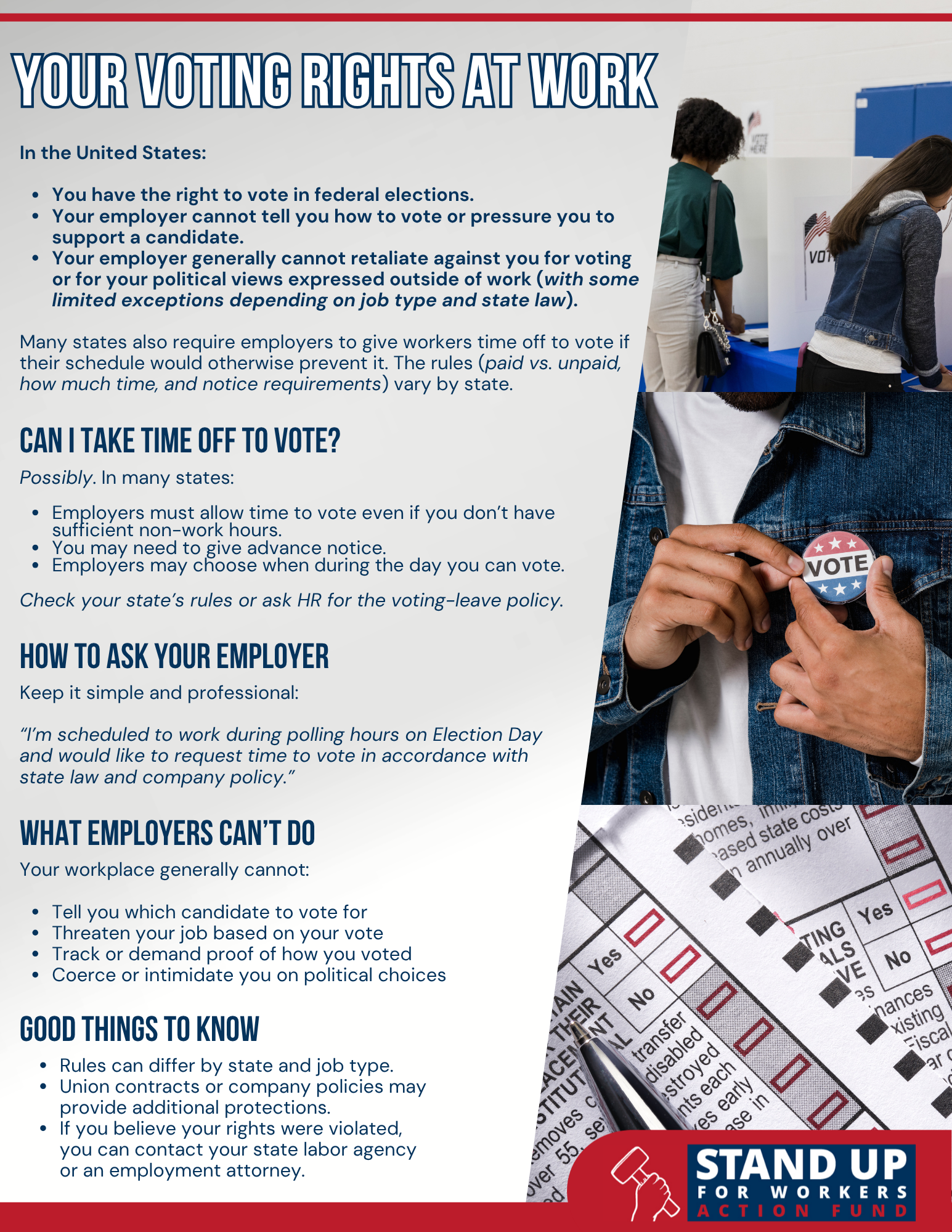
New Resource: Voting Rights at Work

Whether you’re working a shift, managing a team, or balancing a packed schedule, you have rights that protect your ability to vote.

This resource is designed to help you and your network understand what those rights are, how to use them, and how to plan ahead with confidence.

Being informed gives you power as a citizen. Hang this flyer at work. Share it with colleagues. Send it to your group chat.

Trump’s War On Iran Will Add to American Workers’ Economic Woes

American workers, already whipsawed by the effects of Trump’s capricious tariffs and other uncertainties of the economy, are likely to be the group most adversely impacted by the war against Iran according to labor economists and other economic analysts. 

Such effects include:

1. Jobs, Hiring, and Economic Stability

While direct job losses are hard to predict, the indirect effects are clearer and concerning. If the conflict drags on, consumer spending may fall, businesses may slow hiring, and layoffs could follow.

A major disruption is already underway: the near shutdown of oil tankers through the Strait of Hormuz, a critical passage for roughly 20% of global petroleum shipments. Oil prices jumped nearly 10% after the conflict began, raising costs across industries from shipping to manufacturing.

This threatens a fragile recovery in U.S. manufacturing. Rising input costs for energy, materials, and transportation are already surging at their fastest pace in years. As production becomes more expensive, companies may scale back operations, cut hours, or reduce their workforce.

Supply chain vulnerabilities extend beyond oil. For example, a prolonged closure of the Strait could choke off a significant portion of the world’s helium supply—critical for semiconductors, medical equipment like MRI machines, and defense technologies—putting additional jobs at risk.

At the same time, the growing reliance on digital infrastructure leaves businesses exposed to cyberattacks. Iran and its allies have historically used cyber warfare in response to military conflict, and disruptions could halt business operations, threatening jobs across sectors.

2. Rising Costs for Everyday Life

Workers will also feel the impact at homeespecially through rising energy and food costs.

Gasoline and diesel prices are expected to climb, along with electricity costs driven by higher natural gas prices. These increases hit lower-income workers hardest, particularly those with long commutes, as more of their income is diverted to basic transportation.

Food prices (already a straincould rise further. Higher fuel costs increase the price of transporting goods, while disruptions to fertilizer supplies (much of which originates from the Persian Gulf) could reduce agricultural output. The result: higher grocery bills and tighter household budgets.

3. Long-Term Outlook for Workers

Unlike past wars, this conflict may not produce a significant boost in employment. Advances in technology like drones and automation reduce the need for human labor even during wartime production.

History offers a cautionary note: labor shortages can sometimes strengthen workers’ bargaining power, but they can also accelerate automation, ultimately reducing jobs.

Meanwhile, financial markets are already reacting. Rising energy prices and uncertainty have triggered declines in major stock indexes. If the conflict continues, economists warn of a broader slowdown. Businesses may pull back on hiring or cut jobs altogetherraising the risk of a recession.

As one economist put it, without a clear exit strategy, the economic effects of this conflict could be long-lastingleaving American workers to bear much of the burden.


Written By Paul Merry, SU4W Board Member

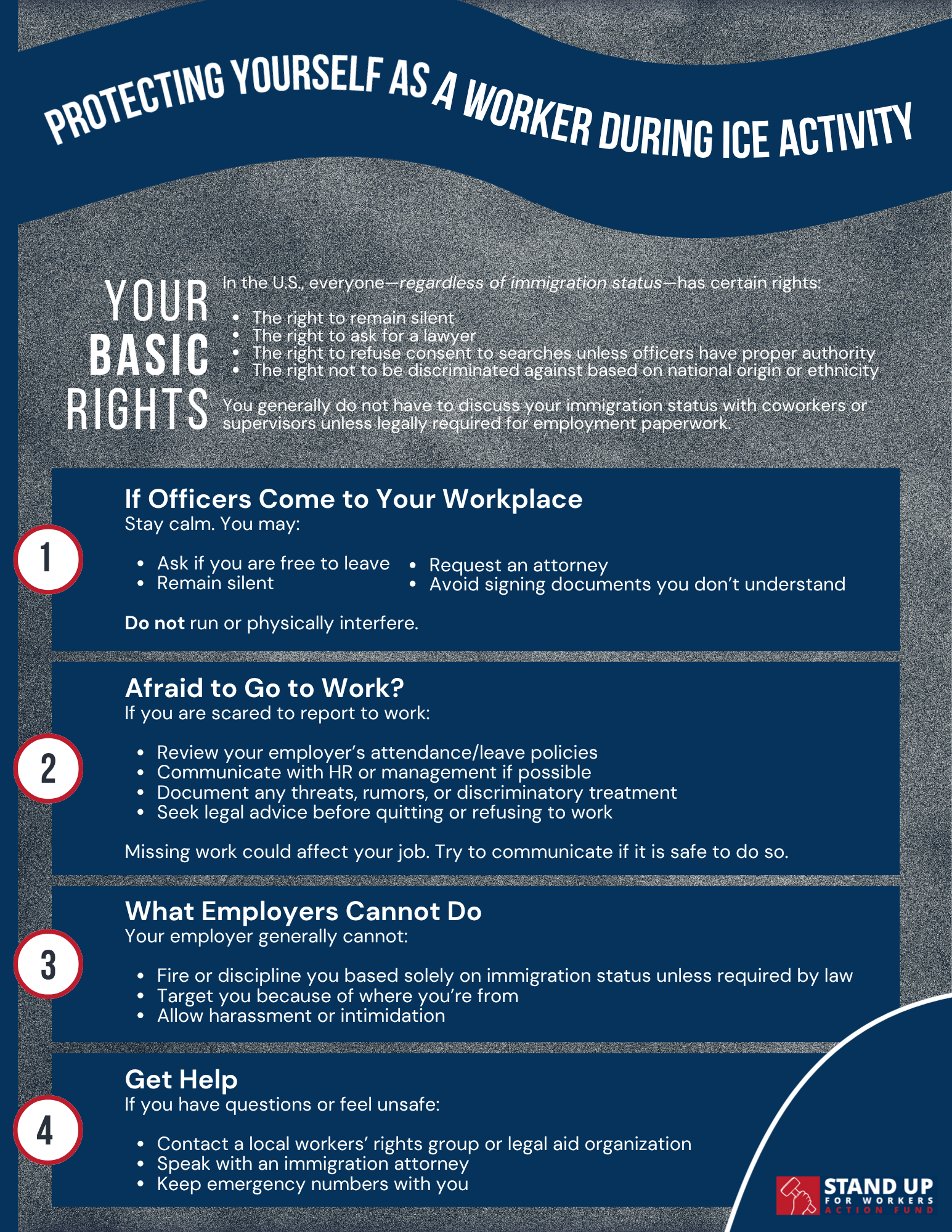
RESOURCE: Protecting Yourself During ICE Activity

In the U.S., everyone, regardless of immigration status, has certain rights. As ICE activity continues across U.S. cities, it’s important to know what these rights are. Consider sharing this resource with your network or in your workplace.

Note: This resource highlights federal rights. These may vary by city and state.

Oregon Campaign for Just Cause

On November 3, 2026, Oregon voters may have the opportunity to approve a fundamental revision in the employment laws of that state. That revision would reverse a doctrine that has been adopted in all but one American state, and that has been used to destroy labor unions, weaken the protections adopted by the Congress and the Oregon legislature, and impair the respect that American workers receive for the work they perform.

The doctrine has a name: employment at will. It was first articulated in a treatise on employment rights in 1877, written by a railroad lawyer, and it was soon adopted as part of the legal regime supporting the Industrial Revolution. The doctrine claims that every employment for an indefinite period of time – that is, virtually every job in America – can be terminated at the will of the employer, without a reason, at any time, with no right to recover damages. The prior rule was that every “hiring” would be for a period of one year.

The new doctrine of employment at will has been rejected by every other industrialized nation. In the U.S., only Montana and Puerto Rico require that every contract of employment can be terminated only for just cause. Under this doctrine, employees have no protection from being fired for arbitrary reasons, without any prior warning or prior discipline, even if they have worked effectively for their employers for years. Some employers have established policies and procedures that seem to promise fair treatment, but then state that those provisions are not contractual and cannot be the basis for a lawsuit.

According to a recent national survey of workers:

  • 69% of workers said their employment was terminated for no reason or for what they claimed to be an unfair reason
  • 75% of workers were fired without warning or any opportunity to improve their work performance

Workers routinely accept demeaning, unsafe or even dangerous working conditions to avoid being disciplined or fired:

  • 59% of workers have skipped work breaks
  • 57% of them have worked overtime when they would have preferred not to work
  • 44% of workers have put up with verbal abuse from a manager or supervisor
  • 35% of workers have worked under dangerous or unsafe conditions
  • 33% of them accepted less pay than what was owed to them

This affects the health and safety of workers. In order to avoid being disciplined:

  • 66% of workers have worked while sick or injured
  • 47% of them postponed medical care
  • 45% of them neglected important family responsibilities or events

Oregon Initiative 36, if adopted by the voters, would eliminate the doctrine of at will, and would restore the respect that Oregon workers deserve. It would require that all Oregon employees, other than seasonal employees and employees hired for a specific term, would have four rights:

A property right to employment. All Oregon employers could impose disciplinary procedures or discharge only based on (a) just cause and due process, and providing (b) a severance payment. Employers would need to provide notice and adequate training on work rules, apply those work rules reasonably and consistently, perform a sufficient and fair investigation, and discipline employees appropriately and proportionately.

A right to good faith notice. Employers would need to notify employees before disciplining or discharging them, inform them of the nature of the investigation and of the alleged facts, and complete any investigation within a reasonable amount of time.

A right to association. Employees would be entitled to representation before being required to answer questions. Interviews generally will be conducted during working hours.

A right to security. Employees will be entitled to severance pay from the date of hire, unless for a seasonal layoff.

A right to remedy. Employees shall have a private right of action to seek relief and compensation for severe disciplinary action without just cause, and to seek just compensation severance, including prevailing plaintiff attorney fees.

The proponents for Oregon Initiative 36 are now working to gather no less than 156,231 petition signatures to get that measure on the November 2026 ballot. Working with their allies in the labor union movement, Jobs with Justice, the National Employment Law Project, the Democratic Party of Oregon, Democratic Socialists of America and Democratic Socialists of America, they will be circulating petitions at events in Oregon and doing other canvassing in the next four months. That will include the No Kings marches on March 28, the Portland Rose Festival, sports events, county fairs, farmers’ markets, and every place that people come to gather and to enjoy the spring and early summer weather.

This initiative will have strong bipartisan support. Just-cause policies are supported by 66% of all workers, including by:

  • 61% of Republican workers
  • 66% of Democratic workers
  • 72% of independent workers

This point is worth repeating. We are living in a time of intense political polarization in the United States. 64% of voters feel that the American political system is too politically divided to solve the nation’s problems. 80% of all adults feel that members of the opposite political party not only disagree about plans and policies, but cannot agree on basic facts.

Nearly half of adults feel that members of the opposing political party are “downright evil.” In this climate, it is remarkable that nearly identical percentages of workers from both political parties support just-cause policies. In fact, support for this pro-worker measure is strongest among independents, not by political partisans! Those policies are supported by two-thirds of all workers!

You can donate funds to support this effort at www.OUJC.org/Give. Donations are not tax-deductible. We encourage you to support this important initiative.

Written By Barry Roseman, Stand Up For Workers Board Member

The Gavel and Your Paycheck: Why the Latest Judicial Nominations Matter for Every American Worker

Whether you are a barista, a middle manager, or a factory supervisor, you probably don’t spend your Tuesday mornings checking the federal judicial nomination list. It feels like “D.C. noise”—distant, political, and largely irrelevant to your daily shift.

But as a plaintiff’s lawyer in Austin, TX who fights for workers nationwide, I’m here to tell you: The person sitting behind that federal bench may have more power over your career than your own boss does.

And, the current administration is changing the game on judicial nominations and the face of the judiciary in a way that may harm workers’ rights for decades to come. As we start 2026, the rules of the game are changing, and politics is to blame. If you’ve ever dealt with employment law or care about these issues, the latest news from Washington should be on your radar.

Recent reports from Reuters confirm that the administration has launched into 2026 with four new judicial nominees, including Anna St. John, nominated to the U.S. District Court for the Eastern District of Louisiana (Reuters, Jan 7, 2026). St. John comes from the Hamilton Lincoln Law Institute, a group known for its “crusade” against class action settlements—the very tool workers use to band together when a company steals wages or discriminates on a mass scale.

This follows a year of rapid appointments aimed at reshaping the courts with younger, “originalist” judges. Some of these lifetime appointees have raised serious alarms. For instance, Whitney D. Hermandorfer, a 37-year-old nominee for the Sixth Circuit, has faced intense scrutiny for her lack of trial experience and her history as lead counsel defending restrictive state laws that intersect with worker privacy and health (Truthout, June 10, 2025).

At the same time, Bloomberg Law notes a significant change in how these nominees are being revealed. By bypassing traditional vetting periods—shrinking the window from the standard 28 days to as little as 48 hours for some nominees—the opportunity for regular citizens and legal experts to scrutinize these lifetime appointments has virtually vanished (Bloomberg Law, Nov 10, 2025).

Why does this matter to the average worker? Because these judges generally have a broad skepticism of worker protections and a deep-seated affinity for corporate autonomy. Furthermore, we are seeing a judiciary increasingly friendly to mandatory arbitration. You likely signed one of these in a stack of paperwork on your first day. It’s a clause that says if the company breaks the law, you can’t sue them in public court. Instead, you have to go to a private, secret hearing.

The 2025-26 nominees are largely pro-arbitration and anti-class action. This means that for the millions of Americans in retail, healthcare, and tech, the “right to a trial” is becoming a relic of the past. When judges refuse to strike down unfair arbitration clauses or make it impossible to file a class action, they effectively hand large corporations a “get out of jail free” card.

The law is only as strong as the person interpreting it. While 2026 brings new challenges for the American worker, it doesn’t mean you and I are powerless. It just means you have to be smarter, better prepared, and more involved than before.

Lifetime appointments mean these decisions will affect not just your current job, but your children’s jobs. We must use the ballot box and our collective voices to ensure that those who hold the gavel actually respect the rights of the people who do the work.

Written By Austin Kaplan, SU4W Board Member and Attorney at the Kaplan Law Firm, PLLC

Report from the Occupied City of Minneapolis: The Chilling Impact of ICE Operations

I am on the ground in Minneapolis, witnessing a city transformed by fear and uncertainty.

The killing of Renee Good occurred just minutes from my home and Alex Pretti just a few blocks further—a vivid reminder of the pervasive violence that now shadows even the most familiar corners of this beautiful, loving community. I have lived in this city since 1980. We pride ourselves on being a progressive, welcoming place, where diversity is celebrated and kindness is the norm. Today, that sense of safety and belonging feels far away.

The atmosphere here is heavy with anxiety. Many residents, particularly those from Hispanic backgrounds, are afraid to leave their homes, even for essential tasks like buying food. I am one of those old-fashioned people who still receive a daily paper at my door. Just this week I received a heartfelt letter from the Hispanic couple who delivers my newspaper, apologizing for missed deliveries out of fear for their safety. Their words echo the sentiments of countless others, including workers, students, and worshippers who now avoid workplaces, businesses, schools, and churches. The threat of ICE operations has cast a long, dark shadow over everyday life here, prompting many to stay indoors and isolate themselves from the community that we all love.

The local economy is also visibly suffering. Minority-owned businesses, once vibrant centers of commerce and culture, are now struggling as customers and employees alike stay away.  Widespread stories of raids and detentions have sent shockwaves through the business community, leading to reduced economic activity and loss of income for families dependent on these establishments. The ripple effect extends to schools and churches, where attendance has plummeted, further eroding the social fabric of our city.The current climate in Minneapolis evokes troubling historical parallels. The fear, the suspicion, the sense of being watched and hunted. These are not memories from another time and place, but realities faced by our community today. The indiscriminate nature of the operations here leaves no one untouched, and the psychological toll is immeasurable. It is unspeakable that such conditions exist in a city known for its openness and progressive values.

As if the social and economic challenges were not enough, Minneapolis is now gripped by the bitter cold of winter. The national news reported last night that the city streets were quiet.  Well, no kidding. It was 4 below zero. We are used to the cold, but combine that with ICE, and the effect on the community is unbearable.

Minneapolis is enduring an occupation of fear and uncertainty, its people held captive not just by ICE operations but by a loss of trust, security, a safe home and a stable workplace. Good people are afraid, and the damage to our community—socially, economically, and emotionally—is profound. It breaks my heart to see what is happening here.

Reliable reports place the percentage of undocumented immigrants in Minnesota at 1.5 percent. That’s right, 1.5 percent. Despite that low number, we are being targeted.  Minneapolis is a politically progressive city, the first district in the country to elect a Muslim representative to Congress. The relationship between our politics and the target on our back is unmistakable, and that should make us all consider where we are and what we need to do.

Written By James Kaster, Founder and Chair of Stand Up For Workers and Partner at Nichols Kaster in Minneapolis.

What “Just Cause” Really Means and Why Workers Need It Now More Than Ever

What “Just Cause” Really Means and Why Workers Need It Now More Than Ever

Most U.S. workers can be fired for almost any reason under the at-will system. But imagine a workplace where termination had to be fair, documented, and based on real evidence instead of personal bias, convenience, or political pressure.

That’s what just cause provides.

“Just cause” is a standard that requires employers to show a legitimate, well-supported reason for firing or disciplining a worker. It’s commonly found in union contracts and in a few jurisdictions with strong worker protections.

Under just cause, an employer must demonstrate:

  1. A clear rule existed
  2. The rule was reasonable
  3. The worker was aware of the rule
  4. The employer investigated before disciplining
  5. The investigation was fair and objective
  6. The evidence supported the conclusion
  7. The discipline matched the severity of the offense

This structure protects workers from arbitrary or politically motivated punishment; something especially important in periods of economic instability or governmental transition.

Why Just Cause Matters Right Now

With mass layoffs, automation, AI restructuring, political turnover, and pressures on federal and public-sector employees, workers are more vulnerable than ever to sudden job loss.

Just cause can:

  • Reduce wrongful termination
  • Increase transparency in decision-making
  • Promote fairness and stability
  • Encourage employers to address issues through coaching, not firing
  • Protect workers from retaliation for speaking up about workplace concerns

Several cities and states (most notably, Oregon, where we are supporting the campaign) are exploring just-cause policies as a way to improve job stability, especially for workers who have historically faced discrimination or instability in employment.

Even without legal mandates, workers can pursue just-cause protections through:

  • Union contracts
  • Workplace campaigns
  • Community advocacy
  • Policy engagement at the local level

What Workers Can Do

  • Learn whether your employer already has just-cause language in its handbook or collective bargaining agreement.
  • Talk to coworkers about the importance of due process.
  • Document workplace issues and disciplinary actions.
  • Support local legislation that moves away from at-will employment.

Job security shouldn’t be a privilege. It should be a basic expectation.

We’re committed to advancing that expectation to workers across the country. We champion policies that strengthen job security, defend access to the courts, and ensure employers can’t sidestep accountability. When workers understand their rights, and when the law recognizes their humanity, entire communities benefit.

Together, we can build a stronger future where fairness is the norm, not the exception.

Year In Review: Trump’s 2025 Record on Employee Rights

Year In Review: Trump’s 2025 Record on Employee Rights

If you care about labor and employment law issues, you should down a stiff drink and then contemplate this incomplete list of Trump’s destruction of those rights during the first ten months of his second term: 

Employment discrimination 

  • Trump revoked Executive Order 11246, issued by Pres. Lyndon Johnson in 1965, which prohibits employment discrimination by federal government contractors. 
  • He instructed the Department of Justice to ensure that federal contractors and other private parties do not promote Diversity, Equity and Inclusion (“DEI”) programs, without defining just what is a DEI program. 
  • Elimination of DEI programs has resulted in a decline in the hiring of employees of color and of women, and it has increased the incidence of discrimination and bias in the workplace. 
  • He issued several executive orders claiming that there are only two genders and targeting trans people for unequal treatment in a variety of areas, including in the military, in prisons and in passports. 
  • He removed two commissioners and the general counsel of the Equal Employment Opportunity Commission (“EEOC”) without cause. 
  • The EEOC, under its new leadership, has dismissed all of its discrimination cases alleging bias against trans people, removed a rule that said that abortion-related restrictions constitute pregnancy discrimination, and has filed cases involving employees’ religious observances, with a particular focus on “eradicating anti-Christian bias.” 
  • The EEOC has dismissed cases alleging disparate-impact discrimination, that is, where a facially neutral practice has a disproportionately adverse effect on a protected class of employees. 
  • The EEOC has claimed that programs designed to train, mentor or sponsor employees because of their sex, race or national origin are discriminatory. 

U.S. Department of Labor 

  • Trump reduced the minimum wage for employees of federal contractors. 
  • The U.S. Department of Labor (“USDOL”) has proposed abolishing more than 60 regulations, including: 
  • Eliminating federal minimum wage and overtime protections for home health care workers. 
  • Providing that disabled employees can be paid a sub-minimum wage, depriving them of the same minimum wages enjoyed by other employees. 
  • Eliminating anti-retaliation protections for migratory farmworkers. 
  • Rescinding a rule that requires employers to provide seat belts in employer-provided transportation for farmworkers. 
  • Rescinding a rule that requires employers to provide adequate lighting at construction sites. 
  • Limiting the scope of the Occupational Safety and Health Administration’s general safety rule, that applies whenever no specific safety rule is in place. 
  • Stripping Mine Safety and Health Administration district managers of their authority to require mine owners to submit plans for ventilation and to prevent roof collapses in coal mines. 
  • The USDOL has stated that it will not enforce a Biden rule on when a worker is an independent contractor, and has stated that it will revise that rule in a deregulatory direction. 
  • The USDOL has informed an appellate court that it is considering revising a Biden rule that substantially increased coverage of the overtime provisions for salaried employees. 
  • The Trump administration has moved from expansive federal oversight of employment of minors to targeted enforcement and employer-led compliance of federal child labor laws. 
  • Trump has proposed repealing a USDOL policy that restricts 16- and 17-year-old employees from using powered patient lifting devices in nursing homes. 

National Labor Relations Board 

  • He removed the general counsel and one of the members of the National Labor Relations Board (“NLRB”), leaving only two members of that five-member board. 
  • As a result, the Board does not have a quorum and is not able to adjudicate cases, including complaints that employers have committed unfair employment practices. 
  • Trump effectively eliminated the Federal Mediation and Conciliation Service (“FMCS”), an agency that assisted in assisting employers and labor unions in the collective bargaining process. 

Federal Employees’ Rights 

  • Trump fired the chairwoman of the Federal Labor Relations Agency (“FLRA”), an agency that adjudicates disputes between federal agencies and labor unions. 
  • Trump excluded more than 1 million employees in more than 30 federal agencies from union representation. 
  • Trump fired the chair of the Merits Standards Protection Board (“MSPB”), a federal agency that hears appeals of federal employees’ disputes.  Combined with the resignation of another member, that action deprived the MSPB of a quorum for more than eight months. 
  • MSPB hearing officers, their numbers trimmed by budget cuts, are dealing with an overwhelming number of appeals, resulting in delays in resolving their cases.  
  • Trump revoked the federal labor-management forum program, which had enabled federal agencies and their employees to collaborate with each other. 
  • Trump attempted to narrow a Biden executive order that had required federal contractors to sign project labor agreements with subcontractors and associated unions. 
  • Trump fired the head of the Office of Special Counsel, an agency that is supposed to protect federal whistleblowers.  He then nominated Paul Ingrassia to fill that position. 
  • Ingrassia withdrew his nomination because, incredibly, he told a group of fellow Republicans in a text chain that the MLK, Jr., holiday should be “tossed into the seventh circle of hell” and that he has “a Nazi streak.” 

Layoffs of Federal Employees 

  • About 300,000 federal employees have been laid off. 
  • Trump accomplished this by stripping some federal employees of their federal protections, fired probationary employes, urged employees to resign, shut down agencies, implemented reductions in force, and claimed to layoff employees during the shutdown of the federal government. 
  • These layoffs are being contested in the courts, and many have been reversed.  The shutdown-related layoffs have been reversed by statute. 

Written By Barry Roseman, Secretary of the SU4W Board