The Fifteenth Amendment and Callais

I wrote an article in the May issue of the Stand Up For Workers newsletter about the Supreme Court’s decision in Louisiana v. Callais. I only briefly mentioned the Fifteenth Amendment to the U.S Constitution in that piece.

The Callais majority decision effectively determined that Sec. 2 of the Voting Rights Act was unconstitutional, while claiming that it was merely “updat[ing]” the framework for determining whether Sec. 2 has been violated. That was a cynical exercise of the conservative majority’s power. The majority opinion would have been more intellectually honest if it had said what it was doing. The claim that it was just updating the Sec. 2 framework fooled no one.

Sec. 2 was enacted pursuant to both the Fourteenth and Fifteenth Amendments.

The Fifteenth Amendment prohibits the states from “deny[ing] or abridg[ing]” the “right of citizens of the United States to vote” because of their “race.” In fact, the Fifteenth Amendment is the only provision in the Constitution that expressly prohibits racial discrimination.

Southern states diluted Black citizens’ votes by gerrymandering congressional districts as early as the 1870s. The Supreme Court in 1980 rejected a claim of racial dilution pursuant to Sec. 2 because the plaintiffs had not proven that the dilution scheme was done for a racial reason. Congress rejected that interpretation of Sec. 2.

In its 1982 amendments to the VRA, it expressly supported racial-dilution claims and provided that it is not necessary to prove discriminatory intent to prevail on such claims. Congress had the power to adopt the amended Sec. 2 pursuant to the Fifteenth Amendment, which grants Congress the “power to enforce this [amendment] by appropriate legislation.” The Supreme Court, in 1966, decided that “Congress may use any rational means to effectuate the constitutional prohibition of racial discrimination in voting.” The Callais majority concluded that that Fifteenth Amendment power is limited to efforts to end intentional racial discrimination in voting. The majority reasoned that redistricting for partisan reasons does not violate Sec. 2. But voting by Black voters in the South is highly partisan now, as it was in the 1870s and 1880s. Partisan redistricting is racial redistricting, especially in the South, where almost all Black individuals and relatively few white people vote for Democrats. Congress amended Sec. 2 because Southern state legislatures solemnly stated that they had no racial animus is drawing district lines.

That is nonsense. Of course they did, since they knew the penalties of being honest about their intent.

State legislatures are populated and advised by lawyers. State legislators are acutely aware of the importance of legislative district boundaries. They know where the district boundaries are located and know that Black voters in the South overwhelmingly vote for Democrats.

The drawing of district boundaries is an intentional act. Sec. 2 was amended because evidence of racial results is evidence of racial intent. It is not necessary to find direct evidence of racial intent, since that intent is inferred from legislatures’ intentional decisions to create districts that result in racial discrimination.

Callais is written from the perspective of the white majority legal and political system in this country. Black citizens in the South – with the apparent exception of Justice Thomas – understand that racial discrimination is alive and well in their state legislatures. The Voting Rights Act was adopted to end that discrimination. As a result of Callais, that discrimination is alive and well.

It is ironic that as this country celebrates the 250th anniversary of the adoption of the Declaration of Independence, the aftermath of the peculiar institution of slavery continues to rear its ugly head in the heart of this democracy. The Callais decision will destroy Black representation in most of the South, until and unless it is overturned or until Congress abolishes partisan gerrymandering or requires proportional representation for congressional districts.

*******

On June 2, 2026, by a vote of 6-3, a majority of the Supreme Court granted a motion for stay in Allen v. Milligan, after a three-judge panel in the Southern District of Alabama concluded that the Alabama state legislature had intentionally discriminated on the basis of race in creating a legislative map that included only one Black-majority congressional district.

The Supreme Court decided in the same case in 2023 that Alabama’s congressional map unlawfully discriminated on the basis of race against Black residents of that state. The district court then held an 11-day trial in which 51 witnesses testified and almost 800 exhibits were exhibited into evidence. The district court concluded that the legislature acted with a discriminatory purpose and not for partisan reasons. The Supreme Court ignored that clear evidentiary record in allowing Alabama to hold an election with only one Black-majority district this year.

Written by Barry Roseman, SU4W Board Member
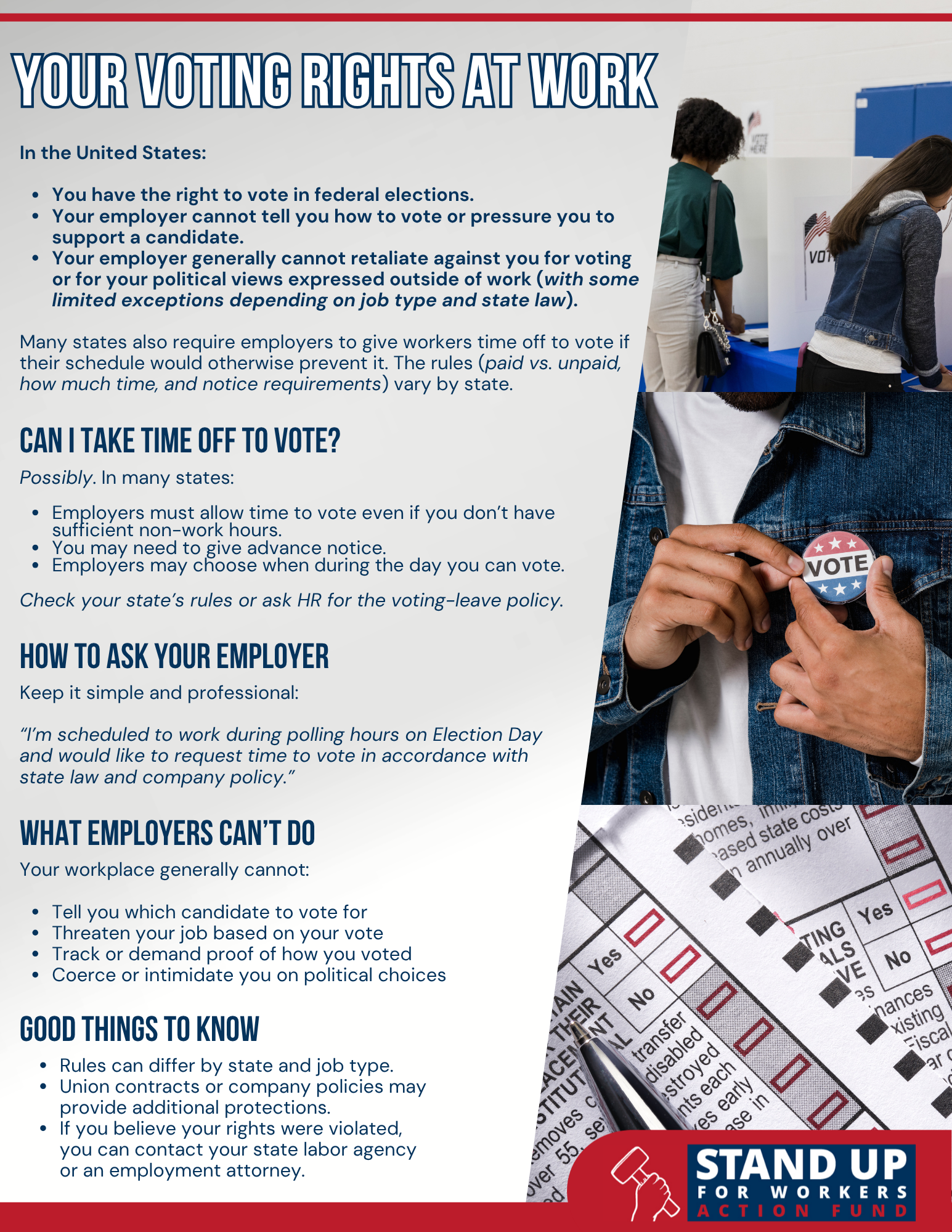
New Resource: Voting Rights at Work

Whether you’re working a shift, managing a team, or balancing a packed schedule, you have rights that protect your ability to vote.

This resource is designed to help you and your network understand what those rights are, how to use them, and how to plan ahead with confidence.

Being informed gives you power as a citizen. Hang this flyer at work. Share it with colleagues. Send it to your group chat.

These Critical Races May Hold The Key to Democratic Senate Majority

While much of the early speculation and conversation around the upcoming midterm elections has centered on whether Democrats can reclaim the House of Representatives, a quieter but increasingly plausible scenario is emerging: a shift in control of the U.S. Senate.

Recent polling trends, including declining approval ratings for Trump, have opened the door to a potential Democratic path to a Senate majority. Political analysts, including SU4W PAC consultant Bighorn Company, have identified a handful of key races that could determine the outcome.

For Democrats to take control, they would need to:

  • Flip at least 4 Republican-held seats
  • Win 2 of the 4 open Republican seats (Michigan, New Hampshire, Iowa, North Carolina)
  • Hold Georgia where Senator Jon Ossoff is up for reelection

It is a challenging map, but not out of reach. Voter frustration over rising living costs, persistent inflation, immigration policies, and foreign policy decisions, including the Iran conflict and its economic ripple effects, has created a more competitive environment. Meanwhile, Republicans are preparing to defend their 53 to 47 majority, already signaling major investments in key battlegrounds including Alaska, Georgia, Iowa, Maine, Michigan, New Hampshire, North Carolina, and Ohio.

With most of these states politically divided, none of these races are guaranteed wins. However, several stand out as especially competitive.

Promising Democratic Opportunities For Success

Maine | Primary: June 9

Democrats are once again targeting longtime Republican Senator Susan Collins. This time, early polling suggests a real opening.  The decision on April 25 by Gov. Janet Mills to end her Senate bid can only improve their chances.  Both she and the other Democratic candidate, oyster farmer Graham Platner, were ahead of Collins in recent polling in this closely watched race. The issue now is whether Platner, running for his first time, can maintain his momentum against the long history of Collins bringing substantial federal dollars into the state, and the large funding national Republicans are certain to provide.

Still, Maine’s recent Democratic lean, including its support for Harris in 2024, makes it one of the Democrats’ best chances. 

Alaska | Primary: August 18

Mary Peltola, former holder of Alaska’s at-large House seat, is emerging as a formidable contender against Senator Dan Sullivan. A member of the Yup’ik tribe, Peltola has strong rural support and narrowly lost reelection in 2024. Recent polling shows her leading Sullivan by five points.  The limited number of undecided voters in the state increases the reliability of this polling.

North Carolina | Primary: May 12

Roy Cooper, the state’s Democratic governor, enters this race leading the polls, with numbers from April 29 giving him a 9-point lead over Republican Michael Whatley. High Point University polling found his lead at 50% to 42%, with 6% undecided. Even Whatley’s term as national Republican chair seems unlikely to overcome his never having held elected office. And in this climate, Trump’s endorsement may not help him.

Cooper’s strong track record, including a double-digit statewide win in 2024 despite Trump carrying the state, makes this one of the Democrats’ best pickup opportunities. Both parties are expected to invest heavily.

Toss-Up Races

New Hampshire | Primary: September 8

Had former Gov. Chris Sununu not reversed his decision against running and thrown his hat into the ring, this race would have been a strong likely Democrat win.  His name recognition and fundraising strength make Sununu a serious contender. With Trump’s strong endorsement, Sununu’s success may also show where Trump stands with voters.

Still, Democrat Chris Pappas brings his own advantages: four terms in Congress, strong fundraising, and broad appeal, particularly among younger voters. Early polling gives him a slight edge.

Ohio | Primary: May 5

Sherrod Brown’s previous loss was close, (by 3.6 points) and he remains a well-known figure in a deeply divided state. Early polling shows him competitive against Republican Jon Husted. Economic concerns, especially inflation and rising gasoline and other costs, could play a decisive role here, making Ohio one of the cycle’s most unpredictable races.

Nebraska | Primary: May 12

In a deeply Republican state, independent candidate Dan Osborn is taking an unusual path, and it may be working. Running outside the Democratic label, he is polling within one point of Republican Pete Ricketts. The Cook political report has shifted the race to favoring him.

A farmer with a strong pro-labor background, Osborn has built a coalition that cuts across traditional party lines.

Long Shot Opportunities

Texas | Runoff: May 12

Democrat James Tallarico could face either incumbent John Cornyn or state Attorney General Ken Paxton. Trump endorsee Paxton has also faced accusations of securities law violations. If Paxton wins the Republican nomination, analysts suggest his vulnerabilities, combined with broader political headwinds, could create an opening.

While still a long shot, this race is worth watching.

Iowa | Primary: June 2

With Senator Joni Ernst retiring, Iowa becomes a rare open-seat Democraticopportunity. Though the state has trended Republican, economic pressures, especially from unpredictable tariffs impacting many farmers, could shift voter sentiment. Democrats Josh Turek and Zach Wahls are competing for the nomination in what could become a competitive race, likely opposing Rep. Allison Hinson.

Florida | Primary: August 18

Florida has leaned Republican in recent years, but strong Democratic performances in recent special elections suggest potential volatility. With well-known Democratic whistleblower Alex Vindman in the race against incumbent De Santis appointee Ashley Moody, and an anti-Trump sentiment prevalent even in many southern states, some observers see a possible opening for the Democrats.

Democratic Vulnerability

Georgia | Primary: May 19

Senator Jon Ossoff is in a seat is critical to any Democratic path to the Senate majority. While Georgia has leaned Republican historically, polling recently reviewed by the New York Times found Ossoff  ahead by four to nine points.

A crowded Republican field could split opposition support, improving his chances, but this remains one of the most closely watched races of the cycle.

The bottom line?

If Democrats secure expected wins in places like Alaska and Maine, they would likely need just 2 more victories, such as in Ohio or New Hampshire, while holding Georgia, to take control of the Senate. It is a narrow path with little room for error. But with shifting political dynamics and a volatile electorate, the next 6 months will tell whether that possibility becomes reality.

Written By Paul Merry, SU4W Board Member

Response to Louisiana v. Callais Decision

The conservative majority of the Supreme Court just completed a project by Chief Justice Roberts, waged for more than four decades, to eviscerate the Voting Rights Act, seriously harming representative democracy in this country.

First, a brief history lesson.

From 1619 to 1865, most African Americans in the U.S. were enslaved, with “no rights which the white man was bound to accept,” as stated in Dred Scott v. Sandford. After the end of the Civil War and the adoption of the 15th Amendment, Black individuals in the South were given and then deprived of voting rights. For nearly 90 years, African Americans were prevented from voting and subjected to Jim Crow laws in the former Confederate States. That ended, formally, in 1965, with the Voting Rights Act. But, John Roberts began working to eliminate the VRA’s protections as a young lawyer in 1982. He completed those efforts with his decision on April 29, 2026 in Louisiana v. Callais.

The VRA has two enforcement provisions in Sections 2 and 5. The pre-clearance language in Sec. 5 required legislatures in certain states, principally in the South, to clear any changes to voting procedures in advance with the U.S. Department of Justice. The Supreme Court decided in Shelby County v. Holder in 2013 that those pre-clearance provisions were no longer needed because “things had changed dramatically” since 1965 and “Congress must ensure that the legislation it passes to remedy that problem [racial discrimination in voting] speaks to current conditions.”

It is true that the former restrictions against Black voters, such as poll taxes, had disappeared in those years, but racial discrimination in voting persisted. Those states, predictably, immediately began enacting voting restrictions against African American voters. Section 2 still offered the possibility of attacking legislative redistricting that adversely affected Black voters. For decades, Southern legislators have “packed” Black citizens into a few districts and “cracked” other African American voters into white majority districts. Roberts hollowed out Section 2, which was used in those voting dilution cases, in Callais.

The heart of the majority opinion in that decision is a new requirement for challenges to a redistricting scheme. The plaintiffs now need to show the new district lines are not done for partisan purposes. Since the vast majority of Black voters in the South are Democrats, districting to support the Republican party is therefore also done for racial reasons. Partisan redistricting is racial districting in the South.

The Louisiana secretary of state declared an “emergency” after Callais was handed down. The clear purpose of that declaration, declared three days before primary voting in that state was scheduled to begin, is to redistrict either or both of the congressional districts now represented by Black individuals in Louisiana. Up to twelve Black- represented districts now are in peril of racial dilution. In 2019, the Supreme Court decided, in Rucho v. Common Cause, that claims of partisan gerrymandering cannot be brought in federal court despite the fact that partisan gerrymandering is a blatant violation of the First Amendment.

The First Amendment prohibits the government from taking an action based on the viewpoint of a speaker, especially when the speech is political and when the action harms the speaker. A person cannot be deprived of a business license because of that person’s speech, but that same person can be deprived of the right to have effective representation because of speech and association with others. The Supreme Court decided in Rucho not that such partisan gerrymandering was legal, but rather that it would not do anything about it. Callais will result in racial gerrymandering that will deprive Black voters in the South of representation by legislators who support their interests. Rucho deprives all voters of the right to be represented by people who support their interests.

The branch of the federal government that is not selected by the voters, populated by judges with life terms, has decided to destroy representative democracy in this country. It is thwarting the will of Congress. It is deciding these cases based on a fictional view of reality. It is exaggerating the partisan divide in the states by incentivizing Democratic legislators to redistrict to favor Democrats and Republican legislators to favor Republicans.

The conservative justices on the Supreme Court are now politicians in black robes. That could destroy the Court, or representative democracy, and maybe both. If the voters do not elect a Democratic majority in the House and the Senate in 2026, and if that majority does not effectively address this issue, Black legislators and representative democracy will be in mortal danger.

Help us move the needle forward in getting democracy back into Congress during the midterm elections with by making a donation of any amount to the Stand Up For Workers PAC.

Written By Barry Roseman, SU4W Board Member

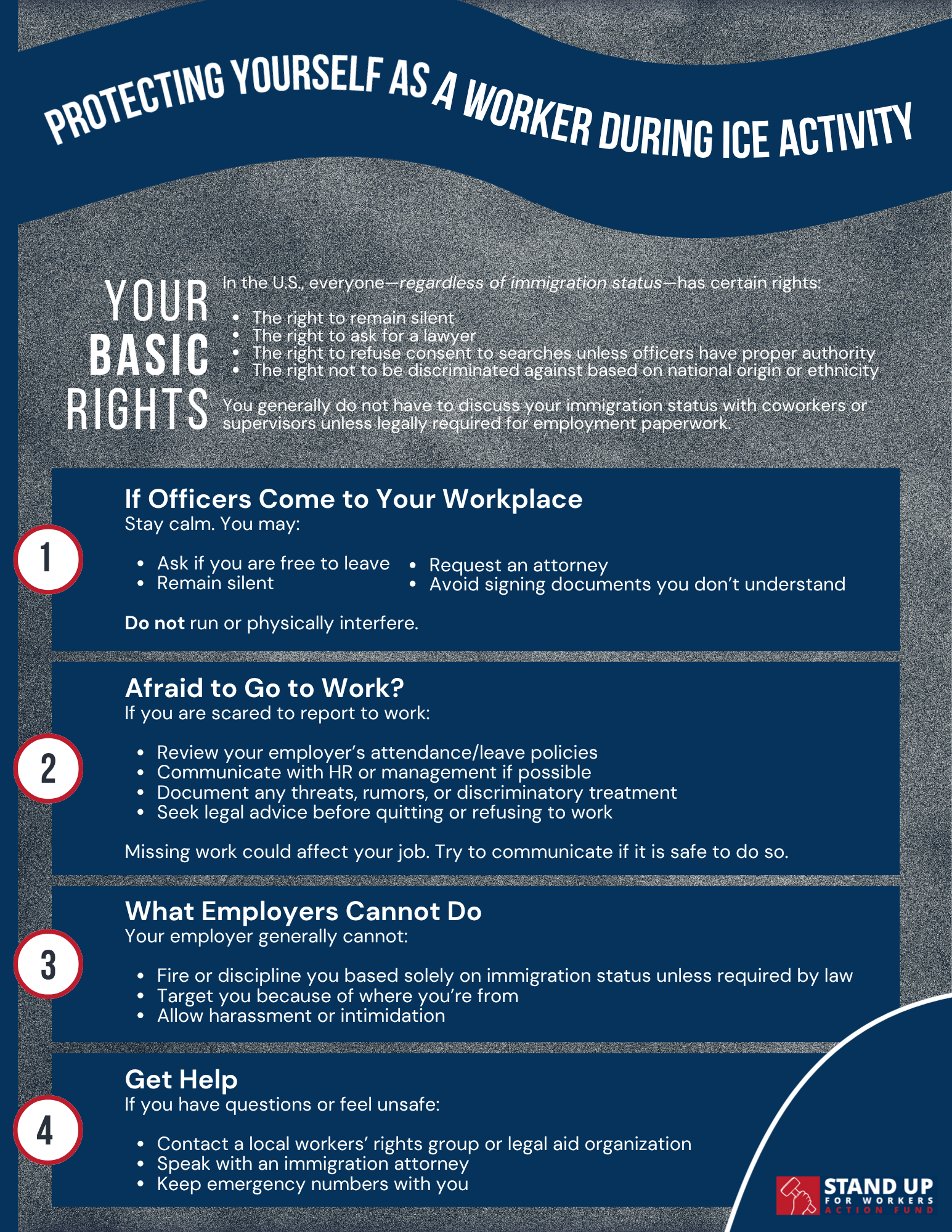
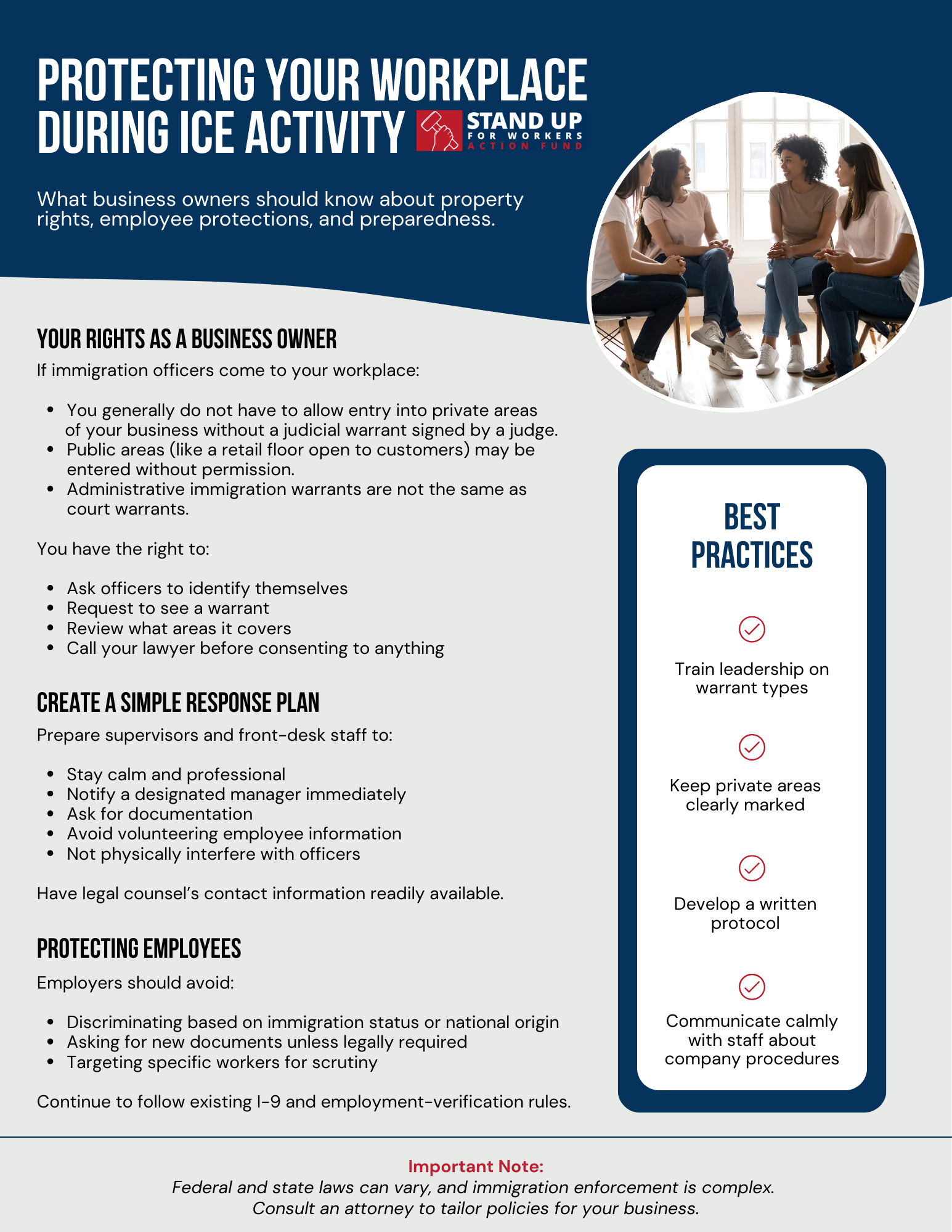
RESOURCE: Protecting Yourself During ICE Activity

In the U.S., everyone, regardless of immigration status, has certain rights. As ICE activity continues across U.S. cities, it’s important to know what these rights are. Consider sharing this resource with your network or in your workplace.

Note: This resource highlights federal rights. These may vary by city and state.

Oregon Campaign for Just Cause

On November 3, 2026, Oregon voters may have the opportunity to approve a fundamental revision in the employment laws of that state. That revision would reverse a doctrine that has been adopted in all but one American state, and that has been used to destroy labor unions, weaken the protections adopted by the Congress and the Oregon legislature, and impair the respect that American workers receive for the work they perform.

The doctrine has a name: employment at will. It was first articulated in a treatise on employment rights in 1877, written by a railroad lawyer, and it was soon adopted as part of the legal regime supporting the Industrial Revolution. The doctrine claims that every employment for an indefinite period of time – that is, virtually every job in America – can be terminated at the will of the employer, without a reason, at any time, with no right to recover damages. The prior rule was that every “hiring” would be for a period of one year.

The new doctrine of employment at will has been rejected by every other industrialized nation. In the U.S., only Montana and Puerto Rico require that every contract of employment can be terminated only for just cause. Under this doctrine, employees have no protection from being fired for arbitrary reasons, without any prior warning or prior discipline, even if they have worked effectively for their employers for years. Some employers have established policies and procedures that seem to promise fair treatment, but then state that those provisions are not contractual and cannot be the basis for a lawsuit.

According to a recent national survey of workers:

  • 69% of workers said their employment was terminated for no reason or for what they claimed to be an unfair reason
  • 75% of workers were fired without warning or any opportunity to improve their work performance

Workers routinely accept demeaning, unsafe or even dangerous working conditions to avoid being disciplined or fired:

  • 59% of workers have skipped work breaks
  • 57% of them have worked overtime when they would have preferred not to work
  • 44% of workers have put up with verbal abuse from a manager or supervisor
  • 35% of workers have worked under dangerous or unsafe conditions
  • 33% of them accepted less pay than what was owed to them

This affects the health and safety of workers. In order to avoid being disciplined:

  • 66% of workers have worked while sick or injured
  • 47% of them postponed medical care
  • 45% of them neglected important family responsibilities or events

Oregon Initiative 36, if adopted by the voters, would eliminate the doctrine of at will, and would restore the respect that Oregon workers deserve. It would require that all Oregon employees, other than seasonal employees and employees hired for a specific term, would have four rights:

A property right to employment. All Oregon employers could impose disciplinary procedures or discharge only based on (a) just cause and due process, and providing (b) a severance payment. Employers would need to provide notice and adequate training on work rules, apply those work rules reasonably and consistently, perform a sufficient and fair investigation, and discipline employees appropriately and proportionately.

A right to good faith notice. Employers would need to notify employees before disciplining or discharging them, inform them of the nature of the investigation and of the alleged facts, and complete any investigation within a reasonable amount of time.

A right to association. Employees would be entitled to representation before being required to answer questions. Interviews generally will be conducted during working hours.

A right to security. Employees will be entitled to severance pay from the date of hire, unless for a seasonal layoff.

A right to remedy. Employees shall have a private right of action to seek relief and compensation for severe disciplinary action without just cause, and to seek just compensation severance, including prevailing plaintiff attorney fees.

The proponents for Oregon Initiative 36 are now working to gather no less than 156,231 petition signatures to get that measure on the November 2026 ballot. Working with their allies in the labor union movement, Jobs with Justice, the National Employment Law Project, the Democratic Party of Oregon, Democratic Socialists of America and Democratic Socialists of America, they will be circulating petitions at events in Oregon and doing other canvassing in the next four months. That will include the No Kings marches on March 28, the Portland Rose Festival, sports events, county fairs, farmers’ markets, and every place that people come to gather and to enjoy the spring and early summer weather.

This initiative will have strong bipartisan support. Just-cause policies are supported by 66% of all workers, including by:

  • 61% of Republican workers
  • 66% of Democratic workers
  • 72% of independent workers

This point is worth repeating. We are living in a time of intense political polarization in the United States. 64% of voters feel that the American political system is too politically divided to solve the nation’s problems. 80% of all adults feel that members of the opposite political party not only disagree about plans and policies, but cannot agree on basic facts.

Nearly half of adults feel that members of the opposing political party are “downright evil.” In this climate, it is remarkable that nearly identical percentages of workers from both political parties support just-cause policies. In fact, support for this pro-worker measure is strongest among independents, not by political partisans! Those policies are supported by two-thirds of all workers!

You can donate funds to support this effort at www.OUJC.org/Give. Donations are not tax-deductible. We encourage you to support this important initiative.

Written By Barry Roseman, Stand Up For Workers Board Member

The Gavel and Your Paycheck: Why the Latest Judicial Nominations Matter for Every American Worker

Whether you are a barista, a middle manager, or a factory supervisor, you probably don’t spend your Tuesday mornings checking the federal judicial nomination list. It feels like “D.C. noise”—distant, political, and largely irrelevant to your daily shift.

But as a plaintiff’s lawyer in Austin, TX who fights for workers nationwide, I’m here to tell you: The person sitting behind that federal bench may have more power over your career than your own boss does.

And, the current administration is changing the game on judicial nominations and the face of the judiciary in a way that may harm workers’ rights for decades to come. As we start 2026, the rules of the game are changing, and politics is to blame. If you’ve ever dealt with employment law or care about these issues, the latest news from Washington should be on your radar.

Recent reports from Reuters confirm that the administration has launched into 2026 with four new judicial nominees, including Anna St. John, nominated to the U.S. District Court for the Eastern District of Louisiana (Reuters, Jan 7, 2026). St. John comes from the Hamilton Lincoln Law Institute, a group known for its “crusade” against class action settlements—the very tool workers use to band together when a company steals wages or discriminates on a mass scale.

This follows a year of rapid appointments aimed at reshaping the courts with younger, “originalist” judges. Some of these lifetime appointees have raised serious alarms. For instance, Whitney D. Hermandorfer, a 37-year-old nominee for the Sixth Circuit, has faced intense scrutiny for her lack of trial experience and her history as lead counsel defending restrictive state laws that intersect with worker privacy and health (Truthout, June 10, 2025).

At the same time, Bloomberg Law notes a significant change in how these nominees are being revealed. By bypassing traditional vetting periods—shrinking the window from the standard 28 days to as little as 48 hours for some nominees—the opportunity for regular citizens and legal experts to scrutinize these lifetime appointments has virtually vanished (Bloomberg Law, Nov 10, 2025).

Why does this matter to the average worker? Because these judges generally have a broad skepticism of worker protections and a deep-seated affinity for corporate autonomy. Furthermore, we are seeing a judiciary increasingly friendly to mandatory arbitration. You likely signed one of these in a stack of paperwork on your first day. It’s a clause that says if the company breaks the law, you can’t sue them in public court. Instead, you have to go to a private, secret hearing.

The 2025-26 nominees are largely pro-arbitration and anti-class action. This means that for the millions of Americans in retail, healthcare, and tech, the “right to a trial” is becoming a relic of the past. When judges refuse to strike down unfair arbitration clauses or make it impossible to file a class action, they effectively hand large corporations a “get out of jail free” card.

The law is only as strong as the person interpreting it. While 2026 brings new challenges for the American worker, it doesn’t mean you and I are powerless. It just means you have to be smarter, better prepared, and more involved than before.

Lifetime appointments mean these decisions will affect not just your current job, but your children’s jobs. We must use the ballot box and our collective voices to ensure that those who hold the gavel actually respect the rights of the people who do the work.

Written By Austin Kaplan, SU4W Board Member and Attorney at the Kaplan Law Firm, PLLC

It’s 2026. Psychological Safety Is a Core Worker Right.

As 2026 begins, workers aren’t just tired. They’re carrying years of accumulated stress from instability, understaffing, and workplaces that demand resilience without offering protection. Burnout is no longer an individual issue. It’s a systems failure.

Psychological safety means more than feeling “comfortable” at work. It’s the ability to speak up about harm, set boundaries, report misconduct, and ask for support without fear of retaliation, dismissal, or being labeled “difficult.” For workers, it’s essential to health, dignity, and long-term participation in the workforce.

From a legal perspective, the foundation already exists. Workers have the right to a workplace free from harassment, discrimination, and retaliation under federal and state laws. Employers are required to engage in good-faith accommodation processes, protect whistleblowers, and address hostile work environments,  including those that cause psychological harm. Yet too often, these rights are under-communicated, inconsistently enforced, or framed as risks to manage rather than responsibilities to uphold.

A burnout-avoidant workplace starts with power-aware practices:

  • Clear, trusted systems for reporting concerns
  • Manager training that prioritizes accountability over control
  • Workloads that are realistic, humane, and transparent
  • Policies that explicitly protect mental health, leave, and accommodations

For advocates and workers alike, 2026 must be the year we stop individualizing burnout and start naming its root causes. Psychological safety is built when workers know their rights, trust that harm will be addressed, and believe they won’t be punished for telling the truth.

What “Just Cause” Really Means and Why Workers Need It Now More Than Ever

What “Just Cause” Really Means and Why Workers Need It Now More Than Ever

Most U.S. workers can be fired for almost any reason under the at-will system. But imagine a workplace where termination had to be fair, documented, and based on real evidence instead of personal bias, convenience, or political pressure.

That’s what just cause provides.

“Just cause” is a standard that requires employers to show a legitimate, well-supported reason for firing or disciplining a worker. It’s commonly found in union contracts and in a few jurisdictions with strong worker protections.

Under just cause, an employer must demonstrate:

  1. A clear rule existed
  2. The rule was reasonable
  3. The worker was aware of the rule
  4. The employer investigated before disciplining
  5. The investigation was fair and objective
  6. The evidence supported the conclusion
  7. The discipline matched the severity of the offense

This structure protects workers from arbitrary or politically motivated punishment; something especially important in periods of economic instability or governmental transition.

Why Just Cause Matters Right Now

With mass layoffs, automation, AI restructuring, political turnover, and pressures on federal and public-sector employees, workers are more vulnerable than ever to sudden job loss.

Just cause can:

  • Reduce wrongful termination
  • Increase transparency in decision-making
  • Promote fairness and stability
  • Encourage employers to address issues through coaching, not firing
  • Protect workers from retaliation for speaking up about workplace concerns

Several cities and states (most notably, Oregon, where we are supporting the campaign) are exploring just-cause policies as a way to improve job stability, especially for workers who have historically faced discrimination or instability in employment.

Even without legal mandates, workers can pursue just-cause protections through:

  • Union contracts
  • Workplace campaigns
  • Community advocacy
  • Policy engagement at the local level

What Workers Can Do

  • Learn whether your employer already has just-cause language in its handbook or collective bargaining agreement.
  • Talk to coworkers about the importance of due process.
  • Document workplace issues and disciplinary actions.
  • Support local legislation that moves away from at-will employment.

Job security shouldn’t be a privilege. It should be a basic expectation.

We’re committed to advancing that expectation to workers across the country. We champion policies that strengthen job security, defend access to the courts, and ensure employers can’t sidestep accountability. When workers understand their rights, and when the law recognizes their humanity, entire communities benefit.

Together, we can build a stronger future where fairness is the norm, not the exception.

Year In Review: Trump’s 2025 Record on Employee Rights

Year In Review: Trump’s 2025 Record on Employee Rights

If you care about labor and employment law issues, you should down a stiff drink and then contemplate this incomplete list of Trump’s destruction of those rights during the first ten months of his second term: 

Employment discrimination 

  • Trump revoked Executive Order 11246, issued by Pres. Lyndon Johnson in 1965, which prohibits employment discrimination by federal government contractors. 
  • He instructed the Department of Justice to ensure that federal contractors and other private parties do not promote Diversity, Equity and Inclusion (“DEI”) programs, without defining just what is a DEI program. 
  • Elimination of DEI programs has resulted in a decline in the hiring of employees of color and of women, and it has increased the incidence of discrimination and bias in the workplace. 
  • He issued several executive orders claiming that there are only two genders and targeting trans people for unequal treatment in a variety of areas, including in the military, in prisons and in passports. 
  • He removed two commissioners and the general counsel of the Equal Employment Opportunity Commission (“EEOC”) without cause. 
  • The EEOC, under its new leadership, has dismissed all of its discrimination cases alleging bias against trans people, removed a rule that said that abortion-related restrictions constitute pregnancy discrimination, and has filed cases involving employees’ religious observances, with a particular focus on “eradicating anti-Christian bias.” 
  • The EEOC has dismissed cases alleging disparate-impact discrimination, that is, where a facially neutral practice has a disproportionately adverse effect on a protected class of employees. 
  • The EEOC has claimed that programs designed to train, mentor or sponsor employees because of their sex, race or national origin are discriminatory. 

U.S. Department of Labor 

  • Trump reduced the minimum wage for employees of federal contractors. 
  • The U.S. Department of Labor (“USDOL”) has proposed abolishing more than 60 regulations, including: 
  • Eliminating federal minimum wage and overtime protections for home health care workers. 
  • Providing that disabled employees can be paid a sub-minimum wage, depriving them of the same minimum wages enjoyed by other employees. 
  • Eliminating anti-retaliation protections for migratory farmworkers. 
  • Rescinding a rule that requires employers to provide seat belts in employer-provided transportation for farmworkers. 
  • Rescinding a rule that requires employers to provide adequate lighting at construction sites. 
  • Limiting the scope of the Occupational Safety and Health Administration’s general safety rule, that applies whenever no specific safety rule is in place. 
  • Stripping Mine Safety and Health Administration district managers of their authority to require mine owners to submit plans for ventilation and to prevent roof collapses in coal mines. 
  • The USDOL has stated that it will not enforce a Biden rule on when a worker is an independent contractor, and has stated that it will revise that rule in a deregulatory direction. 
  • The USDOL has informed an appellate court that it is considering revising a Biden rule that substantially increased coverage of the overtime provisions for salaried employees. 
  • The Trump administration has moved from expansive federal oversight of employment of minors to targeted enforcement and employer-led compliance of federal child labor laws. 
  • Trump has proposed repealing a USDOL policy that restricts 16- and 17-year-old employees from using powered patient lifting devices in nursing homes. 

National Labor Relations Board 

  • He removed the general counsel and one of the members of the National Labor Relations Board (“NLRB”), leaving only two members of that five-member board. 
  • As a result, the Board does not have a quorum and is not able to adjudicate cases, including complaints that employers have committed unfair employment practices. 
  • Trump effectively eliminated the Federal Mediation and Conciliation Service (“FMCS”), an agency that assisted in assisting employers and labor unions in the collective bargaining process. 

Federal Employees’ Rights 

  • Trump fired the chairwoman of the Federal Labor Relations Agency (“FLRA”), an agency that adjudicates disputes between federal agencies and labor unions. 
  • Trump excluded more than 1 million employees in more than 30 federal agencies from union representation. 
  • Trump fired the chair of the Merits Standards Protection Board (“MSPB”), a federal agency that hears appeals of federal employees’ disputes.  Combined with the resignation of another member, that action deprived the MSPB of a quorum for more than eight months. 
  • MSPB hearing officers, their numbers trimmed by budget cuts, are dealing with an overwhelming number of appeals, resulting in delays in resolving their cases.  
  • Trump revoked the federal labor-management forum program, which had enabled federal agencies and their employees to collaborate with each other. 
  • Trump attempted to narrow a Biden executive order that had required federal contractors to sign project labor agreements with subcontractors and associated unions. 
  • Trump fired the head of the Office of Special Counsel, an agency that is supposed to protect federal whistleblowers.  He then nominated Paul Ingrassia to fill that position. 
  • Ingrassia withdrew his nomination because, incredibly, he told a group of fellow Republicans in a text chain that the MLK, Jr., holiday should be “tossed into the seventh circle of hell” and that he has “a Nazi streak.” 

Layoffs of Federal Employees 

  • About 300,000 federal employees have been laid off. 
  • Trump accomplished this by stripping some federal employees of their federal protections, fired probationary employes, urged employees to resign, shut down agencies, implemented reductions in force, and claimed to layoff employees during the shutdown of the federal government. 
  • These layoffs are being contested in the courts, and many have been reversed.  The shutdown-related layoffs have been reversed by statute. 

Written By Barry Roseman, Secretary of the SU4W Board

Candidate Spotlight: Jon Ossoff

Senior U.S. Senator Jon Ossoff of Georgia is one of the first senate candidates  the SU4W PAC supported and is currently being considered for support again as he runs for re-election. 

In his last election in 2020, Ossoff, along with junior Sen. Raphael Warnock, set new “firsts” for Georgia, as Ossoff was the first Jewish candidate, and Warnock the first African-American, to be elected to the U.S. Senate from the state.  Ossoff, whose race has been called the most expensive in U.S. history, defeated Republican incumbent David Perdue in a January runoff election after no candidate won a majority in the general election.  Ossoff’s and Warnock’s victories gave Democrats control of the Senate. At thirty-eight years of age he is currently the youngest senator in office.

Ossoff graduated from Georgetown University‘s Walsh School of Foreign Service with a Bachelor of Science in culture and politics, and earned a Master of Science degree in international political economy from the London School of Economics in 2013. Elements of Ossoff’s background of interest to worker advocates include his serving as intern for civil rights leader and U.S. Representative John Lewis. From 2007 to 2012 he served as legislative assistant for foreign affairs and defense policy for U.S. representative Hank Johnson.

From 2013 to 2021, Ossoff was the managing director and chief executive officer of Insight: The World Investigates (TWI), a London-based investigative television production company that works with reporters to create documentaries about corruption in foreign countries. The firm produced BBC investigations about ISIS war crimes and death squads in East Africa. He invested a previously received inheritance of an unknown amount to the TWI venture.

Ossoff ran unsuccessfully for Congress in 2017.  Though he lost, The New York Times reported that he “produced probably the strongest Democratic turnout in an off-year election in at least a decade“, “brought a surprising number of irregular young and nonwhite voters to the polls,” and nearly doubled youth turnout in the 6th district from the 2014 midterm election, in a district where Republicans far outnumber Democrats.

Ossoff won the support of our PAC by his pledge respecting federal judicial appointments, that if elected he would vote to approve only judicial nominees who have stated their openness to and support of the rights of workers; and by his avowals of commitment to endorsing and promoting legislation that broadens or strengthens worker rights.  Along with SU4W PAC’s endorsement, in the 2020 race he also won the endorsement of the Everytown for Gun Safety Action Fund.

As senator, Ossoff has been active in a variety of areas, but pro-worker legislation has not appeared to be a major focus for him.  He initiated the Solar Energy Manufacturing for America Act, which was passed by the senate in 2022, and which held the promise of more manufacturing jobs.  It was incorporated into the Infrastructure and Jobs Act.  He also sought more control over the U.S. postmaster general in the wake of a mail service meltdown.  Earlier this year the Associated Press noted Ossoff’s bipartisan work with Republicans, advancing the interests of Georgia’s farmers and military bases.

Ossoff voted for the Infrastructure Investment and Jobs Act and the American Rescue Plan Act of 2021, and has supported legislation that significantly benefited workers along with others, including the Affordable Care Act and the Equality Act, which would prohibit discrimination on the basis of sex, gender identity, and sexual orientation.  He has also called for the repeal of “wasteful, anti-competitive special interest subsidies that make it hard for entrepreneurs to raise capital …  [and] create jobs … .”  He describes his support for the LGBTQ community as “unwavering” and supports comprehensive immigration reform with a path to citizenship for immigrants not currently documented.

In 2022, he blocked a proposed titanium mine in the Okefenokee Swamp after the U.S. Fish and Wildlife Service warned of severe potential damage to the wildlife refuge. The mine was proposed by Twin Pines Minerals LLC in 2018.

Alongside his votes supporting workers, however, Ossoff’s Senate record also appears to include at least one less-than-supportive item.  The United Farm Workers and the S.E.I.U. union report that he joined forces with a Republican, Sen. Thom Tillis of North Carolina,  to introduce a bill delaying a five-percent wage increase for H-2A Visa workers for nine months. A March 2022 statement from Tillis announced that Ossoff had joined him in sponsoring the legislation to support farmers.  Ossoff, who the unions note also supported legislation raising the federal minimum wage to fifteen dollars, denies favoring wage cuts for farm workers and points out that he has been a champion for paid leave and for the right to join a union.  Agriculture represents more than five percent of  Georgia’s economy, so it may not be surprising that Ossoff joined in that bill, and it may be that this bipartisan step explains why in one recent poll of voters, Ossoff was supported by some twenty percent of Georgia Republicans.

In the final analysis, living in a democratic system of government calls for pragmatism and compromise.  While Ossoff may not prioritize workers’ rights as highly as advocates may wish, his record overall is almost certainly preferable to the Republican candidate (whoever that turns out to be) for the seat.

Written By Paul Merry, SU4W Board Member