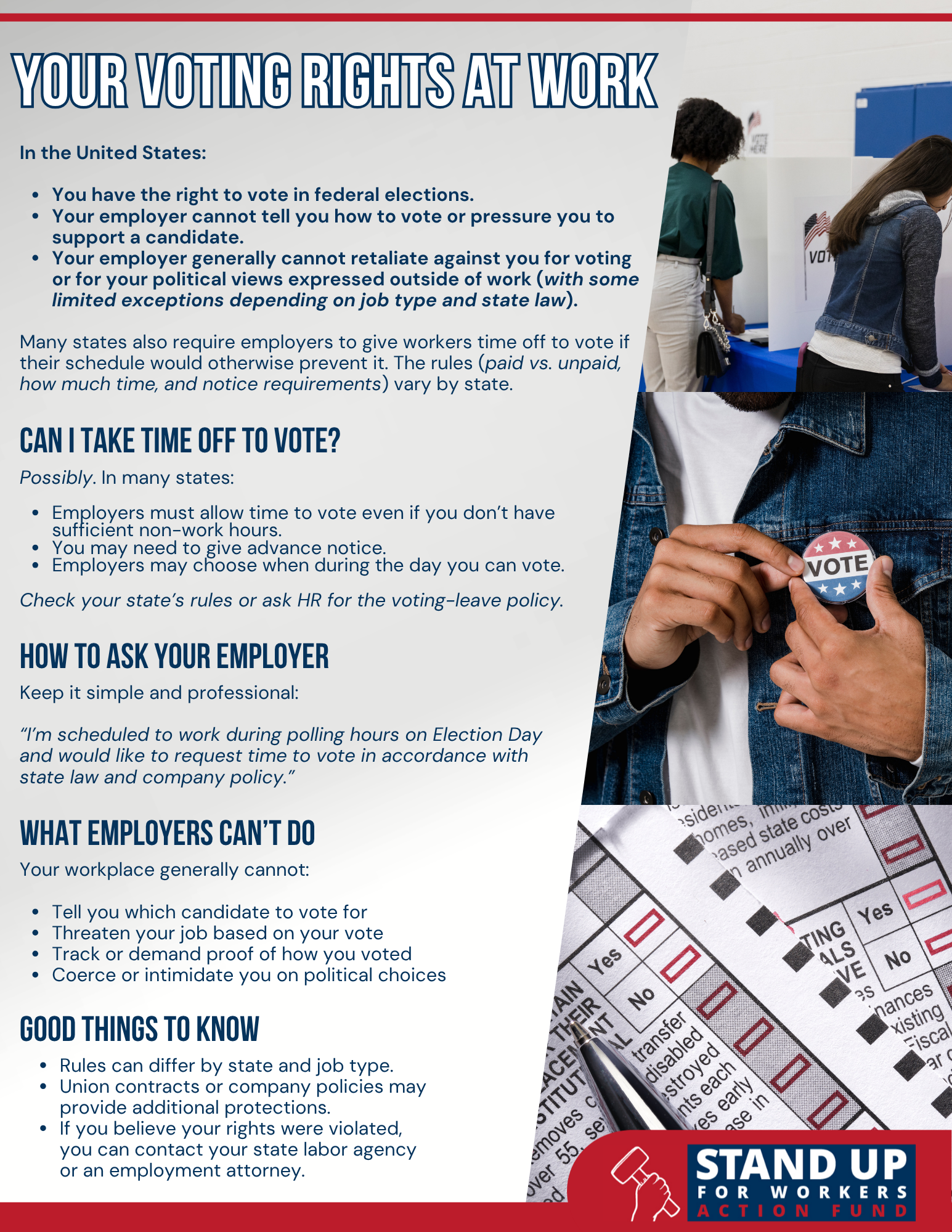
New Resource: Voting Rights at Work

Whether you’re working a shift, managing a team, or balancing a packed schedule, you have rights that protect your ability to vote.

This resource is designed to help you and your network understand what those rights are, how to use them, and how to plan ahead with confidence.

Being informed gives you power as a citizen. Hang this flyer at work. Share it with colleagues. Send it to your group chat.

These Critical Races May Hold The Key to Democratic Senate Majority

While much of the early speculation and conversation around the upcoming midterm elections has centered on whether Democrats can reclaim the House of Representatives, a quieter but increasingly plausible scenario is emerging: a shift in control of the U.S. Senate.

Recent polling trends, including declining approval ratings for Trump, have opened the door to a potential Democratic path to a Senate majority. Political analysts, including SU4W PAC consultant Bighorn Company, have identified a handful of key races that could determine the outcome.

For Democrats to take control, they would need to:

  • Flip at least 4 Republican-held seats
  • Win 2 of the 4 open Republican seats (Michigan, New Hampshire, Iowa, North Carolina)
  • Hold Georgia where Senator Jon Ossoff is up for reelection

It is a challenging map, but not out of reach. Voter frustration over rising living costs, persistent inflation, immigration policies, and foreign policy decisions, including the Iran conflict and its economic ripple effects, has created a more competitive environment. Meanwhile, Republicans are preparing to defend their 53 to 47 majority, already signaling major investments in key battlegrounds including Alaska, Georgia, Iowa, Maine, Michigan, New Hampshire, North Carolina, and Ohio.

With most of these states politically divided, none of these races are guaranteed wins. However, several stand out as especially competitive.

Promising Democratic Opportunities For Success

Maine | Primary: June 9

Democrats are once again targeting longtime Republican Senator Susan Collins. This time, early polling suggests a real opening.  The decision on April 25 by Gov. Janet Mills to end her Senate bid can only improve their chances.  Both she and the other Democratic candidate, oyster farmer Graham Platner, were ahead of Collins in recent polling in this closely watched race. The issue now is whether Platner, running for his first time, can maintain his momentum against the long history of Collins bringing substantial federal dollars into the state, and the large funding national Republicans are certain to provide.

Still, Maine’s recent Democratic lean, including its support for Harris in 2024, makes it one of the Democrats’ best chances. 

Alaska | Primary: August 18

Mary Peltola, former holder of Alaska’s at-large House seat, is emerging as a formidable contender against Senator Dan Sullivan. A member of the Yup’ik tribe, Peltola has strong rural support and narrowly lost reelection in 2024. Recent polling shows her leading Sullivan by five points.  The limited number of undecided voters in the state increases the reliability of this polling.

North Carolina | Primary: May 12

Roy Cooper, the state’s Democratic governor, enters this race leading the polls, with numbers from April 29 giving him a 9-point lead over Republican Michael Whatley. High Point University polling found his lead at 50% to 42%, with 6% undecided. Even Whatley’s term as national Republican chair seems unlikely to overcome his never having held elected office. And in this climate, Trump’s endorsement may not help him.

Cooper’s strong track record, including a double-digit statewide win in 2024 despite Trump carrying the state, makes this one of the Democrats’ best pickup opportunities. Both parties are expected to invest heavily.

Toss-Up Races

New Hampshire | Primary: September 8

Had former Gov. Chris Sununu not reversed his decision against running and thrown his hat into the ring, this race would have been a strong likely Democrat win.  His name recognition and fundraising strength make Sununu a serious contender. With Trump’s strong endorsement, Sununu’s success may also show where Trump stands with voters.

Still, Democrat Chris Pappas brings his own advantages: four terms in Congress, strong fundraising, and broad appeal, particularly among younger voters. Early polling gives him a slight edge.

Ohio | Primary: May 5

Sherrod Brown’s previous loss was close, (by 3.6 points) and he remains a well-known figure in a deeply divided state. Early polling shows him competitive against Republican Jon Husted. Economic concerns, especially inflation and rising gasoline and other costs, could play a decisive role here, making Ohio one of the cycle’s most unpredictable races.

Nebraska | Primary: May 12

In a deeply Republican state, independent candidate Dan Osborn is taking an unusual path, and it may be working. Running outside the Democratic label, he is polling within one point of Republican Pete Ricketts. The Cook political report has shifted the race to favoring him.

A farmer with a strong pro-labor background, Osborn has built a coalition that cuts across traditional party lines.

Long Shot Opportunities

Texas | Runoff: May 12

Democrat James Tallarico could face either incumbent John Cornyn or state Attorney General Ken Paxton. Trump endorsee Paxton has also faced accusations of securities law violations. If Paxton wins the Republican nomination, analysts suggest his vulnerabilities, combined with broader political headwinds, could create an opening.

While still a long shot, this race is worth watching.

Iowa | Primary: June 2

With Senator Joni Ernst retiring, Iowa becomes a rare open-seat Democraticopportunity. Though the state has trended Republican, economic pressures, especially from unpredictable tariffs impacting many farmers, could shift voter sentiment. Democrats Josh Turek and Zach Wahls are competing for the nomination in what could become a competitive race, likely opposing Rep. Allison Hinson.

Florida | Primary: August 18

Florida has leaned Republican in recent years, but strong Democratic performances in recent special elections suggest potential volatility. With well-known Democratic whistleblower Alex Vindman in the race against incumbent De Santis appointee Ashley Moody, and an anti-Trump sentiment prevalent even in many southern states, some observers see a possible opening for the Democrats.

Democratic Vulnerability

Georgia | Primary: May 19

Senator Jon Ossoff is in a seat is critical to any Democratic path to the Senate majority. While Georgia has leaned Republican historically, polling recently reviewed by the New York Times found Ossoff  ahead by four to nine points.

A crowded Republican field could split opposition support, improving his chances, but this remains one of the most closely watched races of the cycle.

The bottom line?

If Democrats secure expected wins in places like Alaska and Maine, they would likely need just 2 more victories, such as in Ohio or New Hampshire, while holding Georgia, to take control of the Senate. It is a narrow path with little room for error. But with shifting political dynamics and a volatile electorate, the next 6 months will tell whether that possibility becomes reality.

Written By Paul Merry, SU4W Board Member

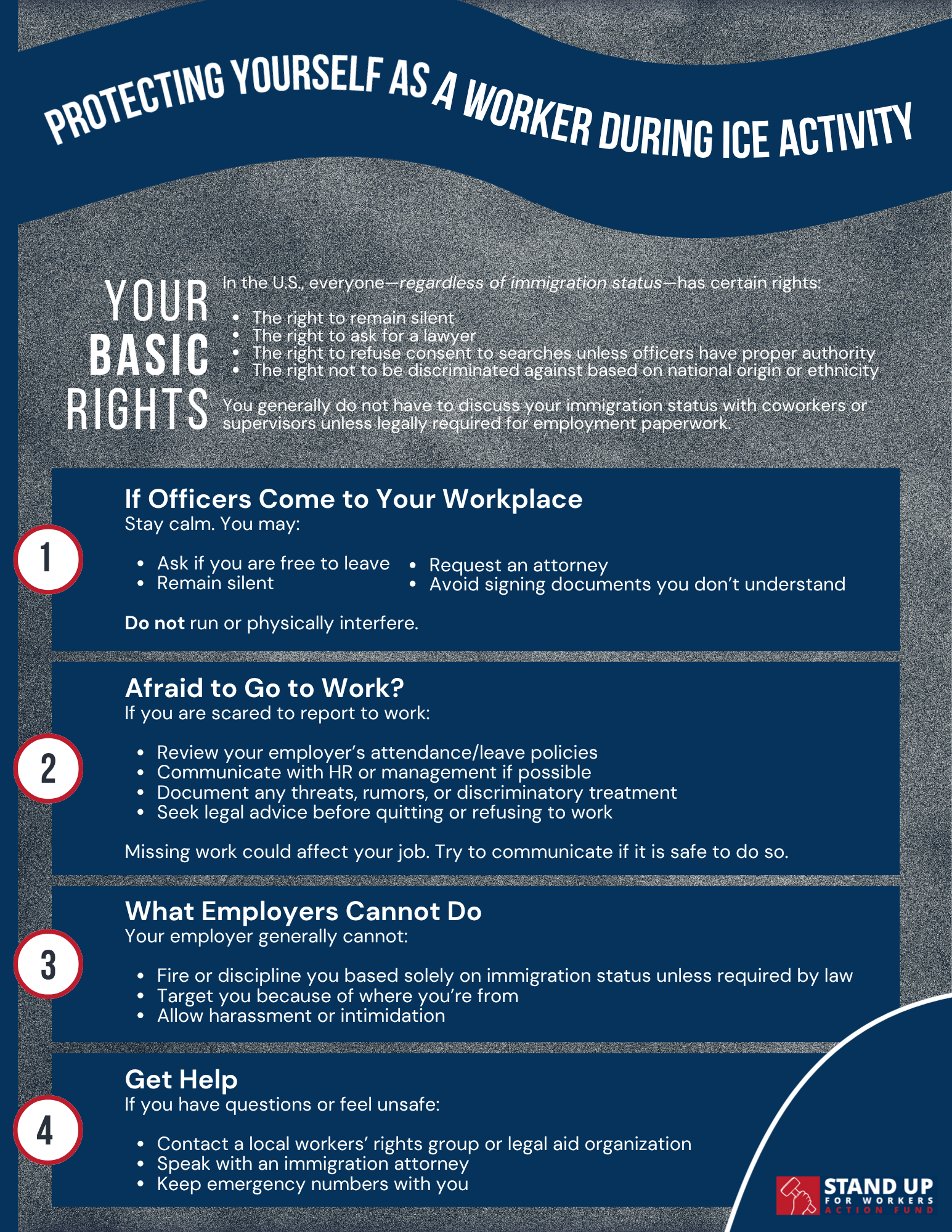
RESOURCE: Protecting Yourself During ICE Activity

In the U.S., everyone, regardless of immigration status, has certain rights. As ICE activity continues across U.S. cities, it’s important to know what these rights are. Consider sharing this resource with your network or in your workplace.

Note: This resource highlights federal rights. These may vary by city and state.

Report from the Occupied City of Minneapolis: The Chilling Impact of ICE Operations

I am on the ground in Minneapolis, witnessing a city transformed by fear and uncertainty.

The killing of Renee Good occurred just minutes from my home and Alex Pretti just a few blocks further—a vivid reminder of the pervasive violence that now shadows even the most familiar corners of this beautiful, loving community. I have lived in this city since 1980. We pride ourselves on being a progressive, welcoming place, where diversity is celebrated and kindness is the norm. Today, that sense of safety and belonging feels far away.

The atmosphere here is heavy with anxiety. Many residents, particularly those from Hispanic backgrounds, are afraid to leave their homes, even for essential tasks like buying food. I am one of those old-fashioned people who still receive a daily paper at my door. Just this week I received a heartfelt letter from the Hispanic couple who delivers my newspaper, apologizing for missed deliveries out of fear for their safety. Their words echo the sentiments of countless others, including workers, students, and worshippers who now avoid workplaces, businesses, schools, and churches. The threat of ICE operations has cast a long, dark shadow over everyday life here, prompting many to stay indoors and isolate themselves from the community that we all love.

The local economy is also visibly suffering. Minority-owned businesses, once vibrant centers of commerce and culture, are now struggling as customers and employees alike stay away.  Widespread stories of raids and detentions have sent shockwaves through the business community, leading to reduced economic activity and loss of income for families dependent on these establishments. The ripple effect extends to schools and churches, where attendance has plummeted, further eroding the social fabric of our city.The current climate in Minneapolis evokes troubling historical parallels. The fear, the suspicion, the sense of being watched and hunted. These are not memories from another time and place, but realities faced by our community today. The indiscriminate nature of the operations here leaves no one untouched, and the psychological toll is immeasurable. It is unspeakable that such conditions exist in a city known for its openness and progressive values.

As if the social and economic challenges were not enough, Minneapolis is now gripped by the bitter cold of winter. The national news reported last night that the city streets were quiet.  Well, no kidding. It was 4 below zero. We are used to the cold, but combine that with ICE, and the effect on the community is unbearable.

Minneapolis is enduring an occupation of fear and uncertainty, its people held captive not just by ICE operations but by a loss of trust, security, a safe home and a stable workplace. Good people are afraid, and the damage to our community—socially, economically, and emotionally—is profound. It breaks my heart to see what is happening here.

Reliable reports place the percentage of undocumented immigrants in Minnesota at 1.5 percent. That’s right, 1.5 percent. Despite that low number, we are being targeted.  Minneapolis is a politically progressive city, the first district in the country to elect a Muslim representative to Congress. The relationship between our politics and the target on our back is unmistakable, and that should make us all consider where we are and what we need to do.

Written By James Kaster, Founder and Chair of Stand Up For Workers and Partner at Nichols Kaster in Minneapolis.

What “Just Cause” Really Means and Why Workers Need It Now More Than Ever

What “Just Cause” Really Means and Why Workers Need It Now More Than Ever

Most U.S. workers can be fired for almost any reason under the at-will system. But imagine a workplace where termination had to be fair, documented, and based on real evidence instead of personal bias, convenience, or political pressure.

That’s what just cause provides.

“Just cause” is a standard that requires employers to show a legitimate, well-supported reason for firing or disciplining a worker. It’s commonly found in union contracts and in a few jurisdictions with strong worker protections.

Under just cause, an employer must demonstrate:

  1. A clear rule existed
  2. The rule was reasonable
  3. The worker was aware of the rule
  4. The employer investigated before disciplining
  5. The investigation was fair and objective
  6. The evidence supported the conclusion
  7. The discipline matched the severity of the offense

This structure protects workers from arbitrary or politically motivated punishment; something especially important in periods of economic instability or governmental transition.

Why Just Cause Matters Right Now

With mass layoffs, automation, AI restructuring, political turnover, and pressures on federal and public-sector employees, workers are more vulnerable than ever to sudden job loss.

Just cause can:

  • Reduce wrongful termination
  • Increase transparency in decision-making
  • Promote fairness and stability
  • Encourage employers to address issues through coaching, not firing
  • Protect workers from retaliation for speaking up about workplace concerns

Several cities and states (most notably, Oregon, where we are supporting the campaign) are exploring just-cause policies as a way to improve job stability, especially for workers who have historically faced discrimination or instability in employment.

Even without legal mandates, workers can pursue just-cause protections through:

  • Union contracts
  • Workplace campaigns
  • Community advocacy
  • Policy engagement at the local level

What Workers Can Do

  • Learn whether your employer already has just-cause language in its handbook or collective bargaining agreement.
  • Talk to coworkers about the importance of due process.
  • Document workplace issues and disciplinary actions.
  • Support local legislation that moves away from at-will employment.

Job security shouldn’t be a privilege. It should be a basic expectation.

We’re committed to advancing that expectation to workers across the country. We champion policies that strengthen job security, defend access to the courts, and ensure employers can’t sidestep accountability. When workers understand their rights, and when the law recognizes their humanity, entire communities benefit.

Together, we can build a stronger future where fairness is the norm, not the exception.

Year In Review: Trump’s 2025 Record on Employee Rights

Year In Review: Trump’s 2025 Record on Employee Rights

If you care about labor and employment law issues, you should down a stiff drink and then contemplate this incomplete list of Trump’s destruction of those rights during the first ten months of his second term: 

Employment discrimination 

  • Trump revoked Executive Order 11246, issued by Pres. Lyndon Johnson in 1965, which prohibits employment discrimination by federal government contractors. 
  • He instructed the Department of Justice to ensure that federal contractors and other private parties do not promote Diversity, Equity and Inclusion (“DEI”) programs, without defining just what is a DEI program. 
  • Elimination of DEI programs has resulted in a decline in the hiring of employees of color and of women, and it has increased the incidence of discrimination and bias in the workplace. 
  • He issued several executive orders claiming that there are only two genders and targeting trans people for unequal treatment in a variety of areas, including in the military, in prisons and in passports. 
  • He removed two commissioners and the general counsel of the Equal Employment Opportunity Commission (“EEOC”) without cause. 
  • The EEOC, under its new leadership, has dismissed all of its discrimination cases alleging bias against trans people, removed a rule that said that abortion-related restrictions constitute pregnancy discrimination, and has filed cases involving employees’ religious observances, with a particular focus on “eradicating anti-Christian bias.” 
  • The EEOC has dismissed cases alleging disparate-impact discrimination, that is, where a facially neutral practice has a disproportionately adverse effect on a protected class of employees. 
  • The EEOC has claimed that programs designed to train, mentor or sponsor employees because of their sex, race or national origin are discriminatory. 

U.S. Department of Labor 

  • Trump reduced the minimum wage for employees of federal contractors. 
  • The U.S. Department of Labor (“USDOL”) has proposed abolishing more than 60 regulations, including: 
  • Eliminating federal minimum wage and overtime protections for home health care workers. 
  • Providing that disabled employees can be paid a sub-minimum wage, depriving them of the same minimum wages enjoyed by other employees. 
  • Eliminating anti-retaliation protections for migratory farmworkers. 
  • Rescinding a rule that requires employers to provide seat belts in employer-provided transportation for farmworkers. 
  • Rescinding a rule that requires employers to provide adequate lighting at construction sites. 
  • Limiting the scope of the Occupational Safety and Health Administration’s general safety rule, that applies whenever no specific safety rule is in place. 
  • Stripping Mine Safety and Health Administration district managers of their authority to require mine owners to submit plans for ventilation and to prevent roof collapses in coal mines. 
  • The USDOL has stated that it will not enforce a Biden rule on when a worker is an independent contractor, and has stated that it will revise that rule in a deregulatory direction. 
  • The USDOL has informed an appellate court that it is considering revising a Biden rule that substantially increased coverage of the overtime provisions for salaried employees. 
  • The Trump administration has moved from expansive federal oversight of employment of minors to targeted enforcement and employer-led compliance of federal child labor laws. 
  • Trump has proposed repealing a USDOL policy that restricts 16- and 17-year-old employees from using powered patient lifting devices in nursing homes. 

National Labor Relations Board 

  • He removed the general counsel and one of the members of the National Labor Relations Board (“NLRB”), leaving only two members of that five-member board. 
  • As a result, the Board does not have a quorum and is not able to adjudicate cases, including complaints that employers have committed unfair employment practices. 
  • Trump effectively eliminated the Federal Mediation and Conciliation Service (“FMCS”), an agency that assisted in assisting employers and labor unions in the collective bargaining process. 

Federal Employees’ Rights 

  • Trump fired the chairwoman of the Federal Labor Relations Agency (“FLRA”), an agency that adjudicates disputes between federal agencies and labor unions. 
  • Trump excluded more than 1 million employees in more than 30 federal agencies from union representation. 
  • Trump fired the chair of the Merits Standards Protection Board (“MSPB”), a federal agency that hears appeals of federal employees’ disputes.  Combined with the resignation of another member, that action deprived the MSPB of a quorum for more than eight months. 
  • MSPB hearing officers, their numbers trimmed by budget cuts, are dealing with an overwhelming number of appeals, resulting in delays in resolving their cases.  
  • Trump revoked the federal labor-management forum program, which had enabled federal agencies and their employees to collaborate with each other. 
  • Trump attempted to narrow a Biden executive order that had required federal contractors to sign project labor agreements with subcontractors and associated unions. 
  • Trump fired the head of the Office of Special Counsel, an agency that is supposed to protect federal whistleblowers.  He then nominated Paul Ingrassia to fill that position. 
  • Ingrassia withdrew his nomination because, incredibly, he told a group of fellow Republicans in a text chain that the MLK, Jr., holiday should be “tossed into the seventh circle of hell” and that he has “a Nazi streak.” 

Layoffs of Federal Employees 

  • About 300,000 federal employees have been laid off. 
  • Trump accomplished this by stripping some federal employees of their federal protections, fired probationary employes, urged employees to resign, shut down agencies, implemented reductions in force, and claimed to layoff employees during the shutdown of the federal government. 
  • These layoffs are being contested in the courts, and many have been reversed.  The shutdown-related layoffs have been reversed by statute. 

Written By Barry Roseman, Secretary of the SU4W Board